Will AI Replace Your Creative Agency? Check the Differences!
Introduction — Will AI replace your creative agency?
Can artificial intelligence take over the role of a creative agency? This question comes up more often as algorithms generate texts, images, or plan publishing schedules in a fraction of the time it takes a team of people. On one hand AI offers scale and speed, on the other — it raises concerns about bias, privacy, and the loss of human empathy. Industry research and analyses (e.g. OCoya, OOH Magazine, academic publications and expert commentary — see Monikę Kołodziejczyk i materiały wideo) show that these are powerful tools, but not without risks (OCoya, OOH Magazine, Springer, Monika Kołodziejczyk, materiały wideo).
In practice, AI in social media supports content personalization, automatic post creation, optimization of publishing times, and moderation — which significantly streamlines marketing activities, but can also reinforce biases or violate privacy. Therefore the role of agencies is evolving: not so much being fully replaced as transforming into creative oversight, strategy, and the ethical implementation of technology.
In the rest of the article we will show where AI shines, where it fails, and how to achieve the best results by combining human creativity with automation. As Lumi Zone we advise low-code/no-code solutions and tools like n8n for secure marketing automation — from creating and publishing content to managing e‑mail campaigns — so you can gain speed and scale without losing quality and control.
Deeper comparison: Algorithms vs AI vs human creativity
How does an algorithm differ from AI?
Algorithms are sets of rules — instructions that a platform executes deterministically (e.g., sorting a feed by date or number of interactions). AI is a layer above: models that learn from data, able to adapt to behavior patterns and predict which content will engage specific users. In practice this means that an algorithm is a recipe, and AI is the head chef who learns the best proportions and flavors and serves a dish tailored to the guest.
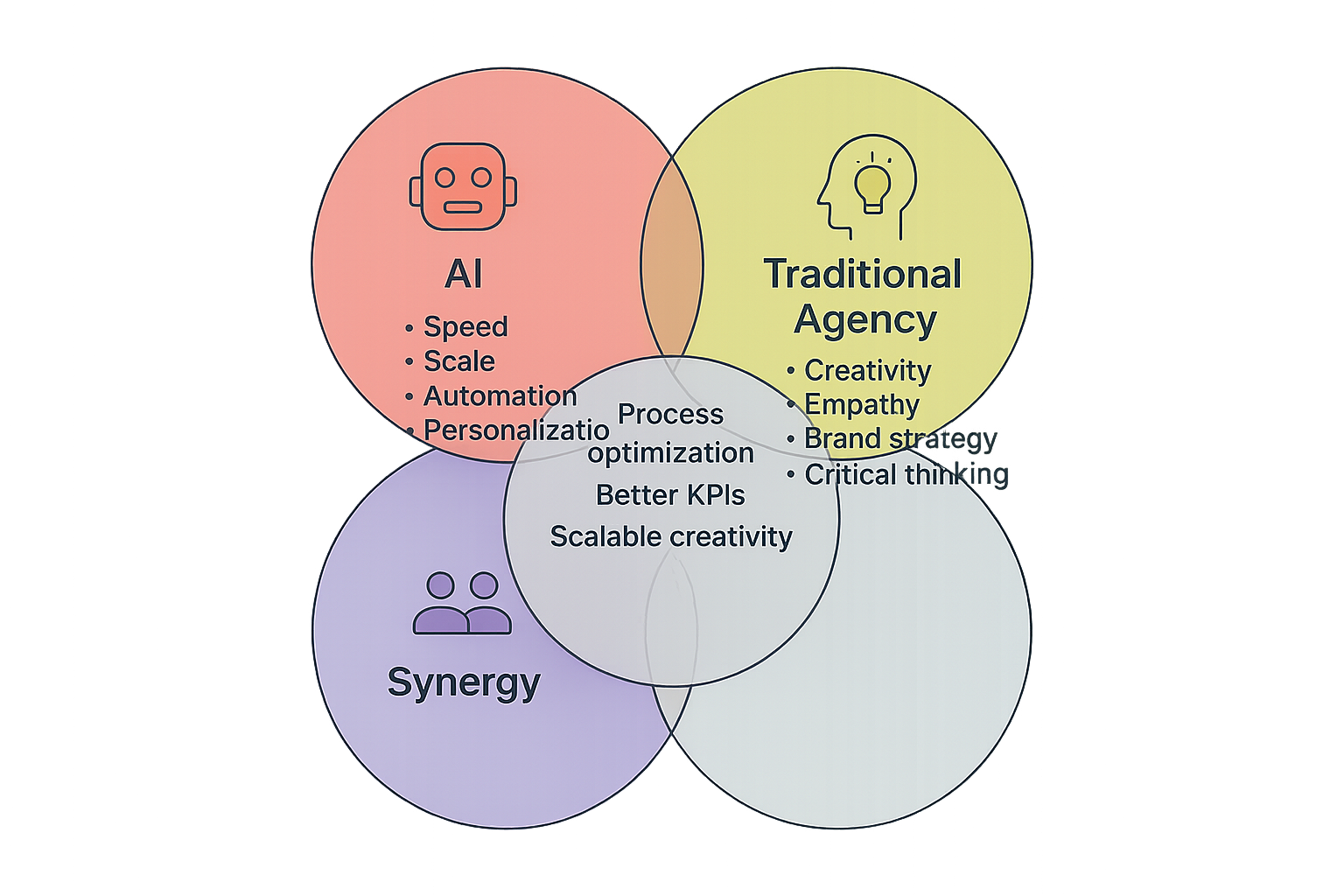
Conclusion: Algorithms execute rules; AI learns and optimizes. Both tools work together, but will not replace a strategy based on human creativity (see OOH Magazine, Monika Kołodziejczyk).
Where AI Shines
- Content personalization: AI analyzes behaviors and suggests content tailored to audience segments — higher CTR and engagement. Example: dynamically selecting images and headlines in a product campaign.
- Publication automation: scheduling posts, optimizing publishing times and A/B tests that AI can run quickly and at scale.
- Moderation and filtering: detecting spam, hate or misinformation using NLP models — the first line of defense for community management teams (more on limitations in Ocoya).
- Chatbots and customer service: automatic responses to FAQs, lead qualification and escalation to a human where empathy is needed.
- Sentiment analysis: quickly extracting insights from hundreds of comments and reviews, accelerating marketing decisions.
Practical benefits: time savings, scalability of activities, faster hypothesis testing and better campaign targeting. Many Lumi Zone clients achieve concrete time savings thanks to low-code/no-code integrations (e.g. n8n) and workflow automation.
Conclusion: AI works well where scale, speed and analysis of large datasets matter (more studies and examples: Monika Kołodziejczyk).
Where a Human Is Necessary
- Brand building and storytelling: it's not just content — it's emotions, cultural context and long-term narrative. AI can help with a draft, but will not replace the brand's voice.
- Communication crisis: in sensitive situations empathy, reputational assessment and a creative approach are required — here a human must take the helm.
- Quality control of moderation: automatic filters can make mistakes (false positives/negatives) and introduce unintended censorship — expert oversight is necessary (see research on bias: Springer).
- Cultural and linguistic context: local nuances, sarcasm, memes — this is an area where standalone AI often loses meaning.
Risks: algorithm bias, erroneous moderation classifications, privacy breaches and loss of cultural context (see also: Ocoya, OOH Magazine, video).
Conclusion: AI is a powerful tool, but not a universal substitute. The best results are achieved when automation supports a creative team and strategic oversight.
How does it look in practice with Lumi Zone? We combine AI and automation (n8n, no-code tools) with a human approach: we automate routine tasks, measure results and leave strategy, narrative and crisis decisions to your team — or to our experts when you want to scale activities without losing quality.
5. Practical guide: how to combine AI with agency services (step by step)
Do you want to publish faster, maintain quality and not lose control over your brand? Below you'll find a practical hybrid implementation plan — designed for small business owners and marketing managers. At the end there's a note about a downloadable checklist that will make step-by-step implementation easier.
Decision criteria: when to automate and when to engage an agency
- Automate when a task is repetitive, measurable and does not require bespoke creativity (scheduling, A/B copy tests, basic moderation).
- Engage an agency when you need strategy, a creative concept, a critical brand review or crisis communication.
- Hybrid: automation of routine + an agency overseeing creative and strategic decisions.
Step by step: hybrid implementation plan
- Content and process audit — map: what content you publish, how much time it takes, what tools you use and where the bottlenecks are.
- Tool selection — prefer low-code/no-code solutions for quick deployment and easy control. Examples: n8n (integrated workflows), no-code platforms for automatic generation of copy and graphics, tools for scheduling publications and moderation.
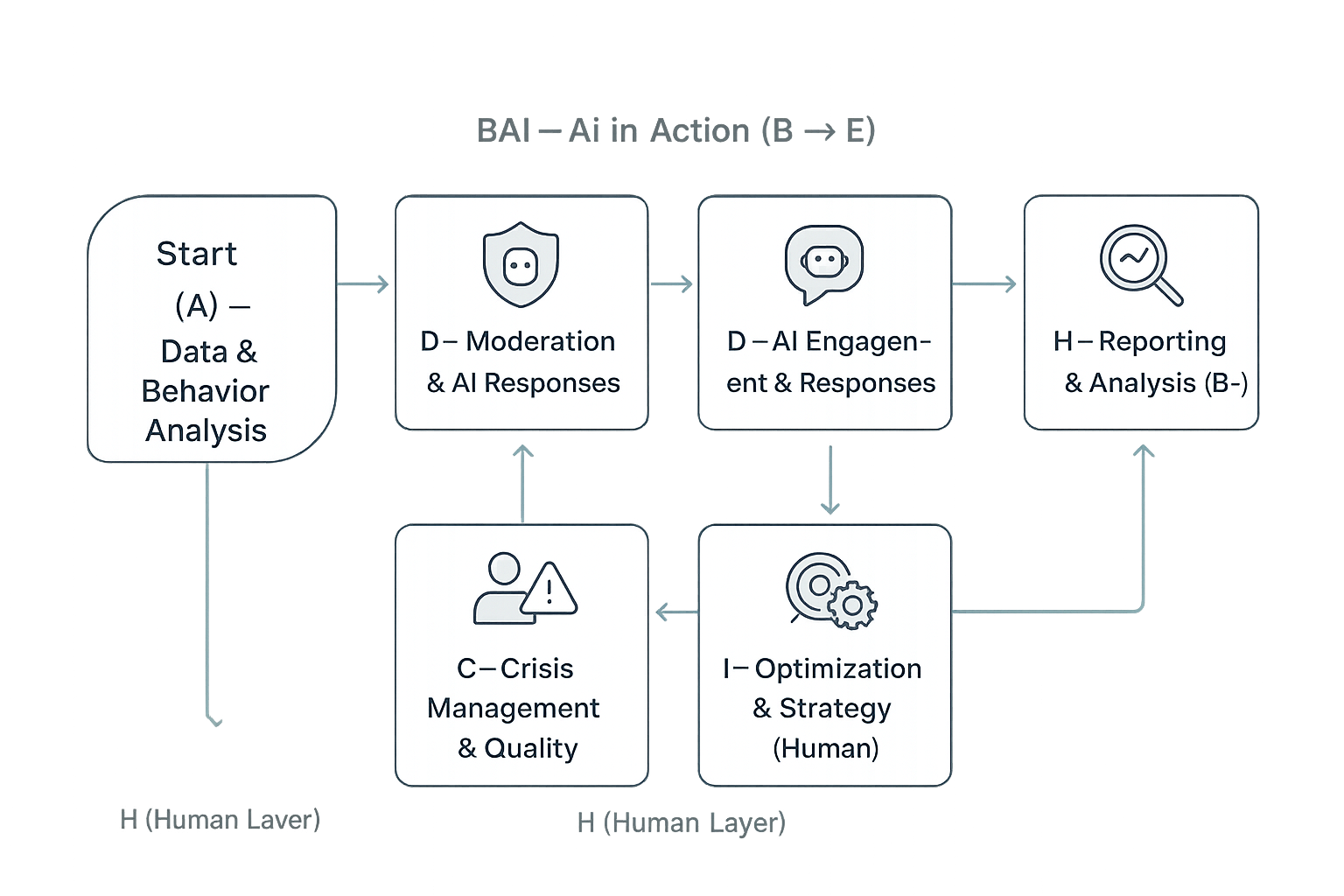
- Design automation flows — design processes: brief collection → generation of 3 copy variants → automatic scheduling → manual approval (if required) → publication.
- Moderation and escalation configuration — filter rules (spam, hate speech), thresholds that trigger a notification to the team and escalation to the agency in case of reputational risk.
- Testing and iteration — implement KPI monitoring and optimize workflows every 2–4 weeks.
Success metrics (KPI)
- Time saved: work hours saved weekly (e.g., from 8h to 2h = 75% savings).
- Engagement: increase in CTR, likes, or comments after optimizing publishing times and personalizing content.
- Cost/effectiveness: comparison of the cost of manual handling vs subscription tool costs + agency labor.
- Quality and response speed: moderation SLA and response time to escalations.
Quick ROI examples
- Automatic scheduling + generating 3 copy variants: a publication that previously took 8 hours of work is reduced to ~2 hours (75% less time). At a rate of 100 PLN/hour this is a saving of 600 PLN per publication cycle.
- Automatic moderation with escalation rules: reduction in manual moderation by 60–80%, which allows the team to be shifted to strategic tasks.
How Lumi Zone can help
- Content and process audit — we identify the most urgent automations and measurable goals.
- Building n8n workflows — we create API integrations, content generation sequences, and publishing automations.
- CRM/MA integrations — we will synchronize customer data, segments, and email campaigns.
- Publishing and reporting automation — we set up KPI monitoring and automatic reports for the team and management.
Do you want a ready implementation checklist? Download our hybrid automation implementation checklist — it will make your audit and first month of work easier. Contact Lumi Zone and we will guide you through every step.
6. Conclusion and call to action
AI is a powerful tool that speeds up work, increases personalization, and opens new opportunities in social media and marketing. However, this does not mean it will replace a creative agency 100%. The best results come from a hybrid model: technology does the heavy lifting, while people retain context, empathy, and quality control.
Here are the final recommendations you can implement right away:
- Conduct a technology audit — check which tools (including n8n) are worth integrating and which are better left to the creative team.
- Test AI via A/B — compare AI-generated content with human-created versions to identify best practices.
- Maintain human quality control — moderation, final edits, and strategic decisions should be overseen by experts.
At Lumi Zone we combine the speed of automation with the team's experience: you'll save time, gain scalability, and receive expert n8n implementation and marketing automation tailored to your company.
Do you want to check where it’s best to introduce AI into your processes? Take advantage of our offer for a free mini-audit of marketing processes. How to do it: send a short brief to kontakt@lumi.zone with the subject “MINI-AUDYT”, or fill out the contact form on lumi.zone/kontakt. In response we will arrange a short, non-binding consultation and propose an initial action plan.
Arrange a free audit — send a brief and see how hybrid solutions can accelerate the growth of your business.