Can a $100 robot replace a $1000 employee? - how to calculate ROI from automation

Introduction: Automation's Provocative Question
The business world constantly seeks efficiency, cost reduction, and competitive advantage. In this pursuit, a question often emerges, sometimes whispered, sometimes debated: "Can a $100 robot replace a $1000 employee?" This is not merely a hypothetical inquiry; it encapsulates the core challenge and opportunity presented by modern automation. While the numbers in the question are stark and intentionally provocative, they highlight a fundamental truth: businesses are increasingly evaluating how technology, particularly AI-driven automation, can perform tasks traditionally handled by human labor, often at a fraction of the cost.
To provide a definitive answer to this complex query, a robust framework for evaluation is essential. This article will delve into the critical discipline of Return on Investment (ROI) analysis, specifically tailored for automation initiatives. Understanding ROI is not just about comparing a robot's cost to an employee's salary; it's about comprehensively assessing the tangible and intangible benefits automation brings against its total implementation and operational costs.
The escalating adoption of automation across industries underscores its growing importance. From routine data entry and customer service interactions to complex operational processes, intelligent systems are reshaping how work is done. However, the mere act of implementing automation is insufficient. Its true value lies in its measurable impact on a business's bottom line and operational efficacy. Therefore, the capacity to accurately measure this effectiveness, to quantify the ROI, becomes paramount.
As experts in AI automation, Lumi Zone understands the intricate nuances of integrating advanced technologies into existing business frameworks. We advocate for a data-driven approach, ensuring that every automation project yields a clear and justifiable return. This article will serve as a guide to dissecting the financial and operational implications of automation, empowering businesses to make informed decisions that transcend mere cost comparisons. By the end, you will possess a clearer understanding of how to calculate the ROI from automation, and critically, how a strategically deployed "robot" can indeed offer immense value, potentially redefining resource allocation within your organization.
Basics of Automation ROI
Return on Investment (ROI) is a fundamental metric used to evaluate the efficiency or profitability of an investment. In its simplest form, it measures the gain or loss generated relative to the amount of money invested. When applied to automation, ROI provides a quantifiable measure of how much financial benefit a business derives from its investment in automated systems, relative to the cost of that investment. Its significance lies in its ability to justify capital expenditure, prioritize projects, and demonstrate the tangible impact of technological adoption.
While the core principle remains consistent, distinguishing between traditional ROI and automation ROI is crucial. Traditional ROI often focuses on direct revenue generation or explicit cost savings from a specific asset or project. Automation ROI, however, frequently encompasses a broader spectrum of benefits. Beyond direct financial savings, it accounts for qualitative improvements such as increased accuracy, enhanced customer satisfaction, improved employee morale due to reduced repetitive tasks, and greater business scalability. These non-financial aspects, while harder to quantify initially, significantly contribute to long-term profitability and competitive advantage.
The basic ROI formula is universally applicable:
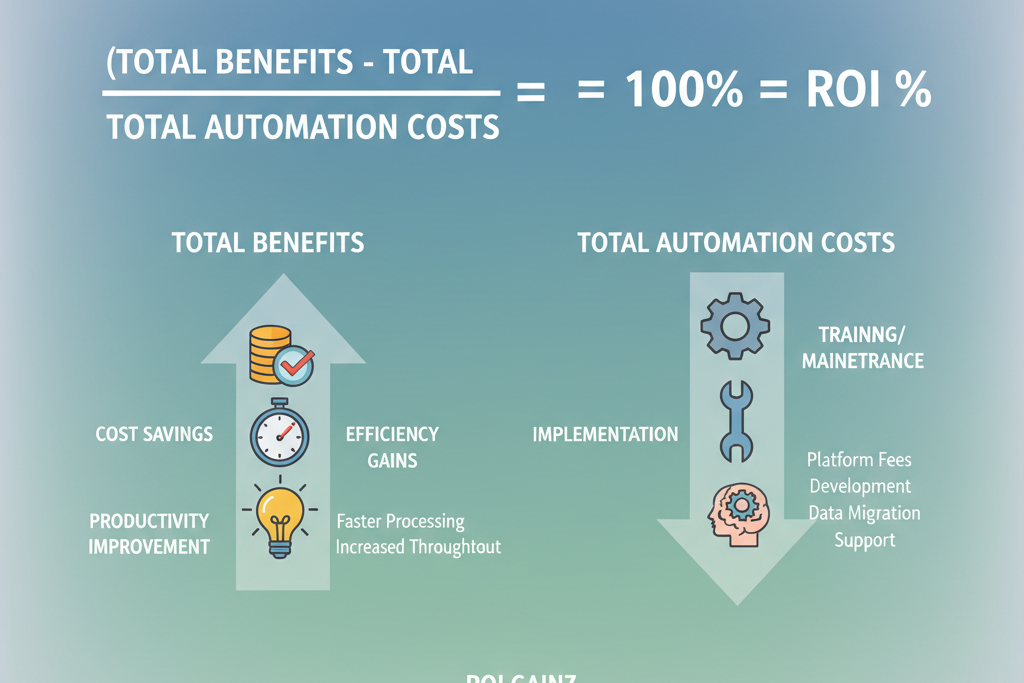
ROI = (Investment Profit - Investment Cost) / Investment Cost × 100%
In this formula:
- Investment Profit: Represents the total financial gains and quantifiable benefits derived from the automation project. This can include savings from reduced labor costs, error reduction, increased throughput, faster processing times, and potentially increased revenue from improved service or capacity.
- Investment Cost: Encompasses all expenditures related to implementing and maintaining the automation. This includes software licenses, hardware, integration services, training, infrastructure upgrades, and ongoing maintenance fees.
For example, if an automation project costs $50,000 and generates $150,000 in savings and benefits over a specified period, the calculation would be:
ROI = ($150,000 - $50,000) / $50,000 × 100% = $100,000 / $50,000 × 100% = 200%
A 200% ROI indicates that for every dollar invested, the business gained two dollars in return. This profitability analysis is vital for stakeholders to understand the value proposition of automation.
However, the nuance of automation ROI lies in accurately valuing "Investment Profit." In addition to direct financial savings (e.g., reduced headcount, lower overtime costs), it must include the monetary equivalent of qualitative benefits. For instance, reducing human error rates can translate into fewer rework costs, improved compliance, and higher customer retention. Faster processing means quicker time-to-market or quicker customer service resolution, indirectly boosting revenue and satisfaction. Therefore, a comprehensive ROI calculation for automation requires a meticulous approach to identifying, quantifying, and monetizing these diverse benefits.

Understanding automation ROI is not just about comparing a robot's cost to an employee's salary; it's about comprehensively assessing the tangible and intangible benefits automation brings against its total implementation and operational costs.
Methodology for Calculating Automation ROI
Calculating the Return on Investment for automation requires a structured, methodical approach. It moves beyond simple cost comparisons to a comprehensive valuation of both expenditures and benefits. Here is a step-by-step methodology to ensure accurate and actionable ROI calculations:
1. Identification of Processes for Automation
Begin by meticulously auditing existing business processes. Identify tasks that are repetitive, rule-based, time-consuming, prone to human error, or involve high volumes of data. Examples include data entry, invoice processing, customer service inquiries, report generation, and system integrations. Prioritize processes that have a significant impact on operational costs or customer experience.
2. Calculation of Current Process Costs
For each identified process, quantify its current operational cost. This involves:
- Human Labor Costs: Calculate the total loaded cost of employees involved in the process. This includes salaries, benefits, taxes, and overhead. Determine the average time spent by employees on these tasks per day, week, or month.
- Error Costs: Estimate the financial impact of human errors, including rework, compliance penalties, lost customer goodwill, and associated investigation time.
- Delay Costs: Assess the cost of process bottlenecks, slow response times, and delayed deliveries, which can impact revenue, customer satisfaction, or lead to missed opportunities.
- Infrastructure/Software Costs: Account for any existing software licenses or infrastructure directly tied to the manual execution of the process.
3. Valuation of Automation Implementation Costs
Accurately detail all costs associated with introducing the automation solution:
- Software Licenses: Annual or one-time fees for automation platforms, AI agents, or specialized applications.
- Hardware: Costs for any new servers, specialized devices, or infrastructure upgrades required.
- Integration Services: Expenses for connecting the automation system with existing CRM, ERP, or other business applications. This is a critical component for seamless operation.
- Development/Configuration: Costs associated with custom development, scripting, or configuring the automation workflows.
- Training: Expenses for training employees who will oversee, interact with, or maintain the automated system.
- Consultation/Project Management: Fees for external consultants or internal project management resources dedicated to the automation rollout.

4. Calculation of Savings and Benefits
Quantify the anticipated improvements and reductions after automation:
- Time Savings: Convert reduced human effort into monetary savings based on loaded labor costs. For instance, if an automated process saves 100 hours of employee time per month, multiply that by the average hourly loaded cost.
- Error Reduction: Estimate the decrease in error-related costs. For example, if automation reduces invoice processing errors by 90%, quantify the financial impact of preventing those errors.
- Quality Improvement: Monetize the impact of higher accuracy, consistency, and compliance. This might include reduced audit costs or improved customer retention due to better service.
- Increased Throughput/Capacity: If automation allows for processing more transactions or serving more customers without additional human resources, quantify the revenue potential or cost avoidance.
- Faster Response Times: Evaluate the financial benefit of quicker customer service, faster order fulfillment, or accelerated report generation.
5. Inclusion of Ongoing Maintenance Costs
Automation systems require periodic maintenance, updates, and potential troubleshooting. Factor in these recurring costs, which might include:
- Subscription Fees: Ongoing costs for cloud-based automation platforms or software licenses.
- Support Contracts: Fees for technical support from vendors.
- Internal IT Resources: Time and cost of internal teams managing and monitoring the automation.
Different Approaches to ROI
- Simple ROI: The basic formula calculated over a specific period (e.g., one year). It provides a quick snapshot but doesn't account for the timing of cash flows.
- Net Present Value (NPV): Considers the time value of money, discounting future benefits and costs to their present value. This is more accurate for long-term projects.
- Internal Rate of Return (IRR): The discount rate that makes the NPV of all cash flows from a particular project equal to zero. Useful for comparing projects with different lifespans.
- Payback Period: The time it takes for the investment to generate enough savings or revenue to cover its initial cost. A shorter payback period is generally preferred.
By following this methodical approach, businesses can gain a clear, defensible understanding of the financial viability and strategic value of their automation investments.
Practical Examples of ROI Calculations
To illustrate the practical application of automation ROI methodology, let's examine specific examples across different industries. These case studies will provide detailed calculations and explain the underlying assumptions, demonstrating how automation can deliver substantial returns.
Example 1: Invoice Processing Automation
Scenario: A medium-sized enterprise processes approximately 1,000 invoices per month. This task is handled manually by one accounts payable employee.
- Current Process Cost (Manual):
- Employee Salary & Benefits (loaded cost): $4,000 per month
- Time spent: 100% of the employee's time on invoice processing
- Estimated error rate: 3% of invoices require manual correction, costing an average of $50 per error in time and resources.
- Total Monthly Cost: $4,000 (labor) + (0.03 * 1000 invoices * $50/error) = $4,000 + $1,500 = $5,500
- Automation Implementation Costs:
- Automation software license & setup: $3,000 (one-time)
- Integration & configuration: $2,000 (one-time)
- Total Implementation Cost: $5,000
- Ongoing Automation Costs:
- Monthly software subscription & support: $500 per month
- Anticipated Savings with Automation:
- Reduced labor: Automation handles 90% of invoices, freeing up 90% of the employee's time for higher-value tasks. This represents a direct labor saving of $3,600 per month (0.90 * $4,000).
- Reduced errors: Automation reduces errors to near zero, saving ~$1,500 per month.
- Total Monthly Savings: $3,600 (labor) + $1,500 (errors) = $5,100
ROI Calculation (over 12 months):
- Total Investment Cost (12 months): $5,000 (setup) + ($500/month * 12 months) = $5,000 + $6,000 = $11,000
- Total Investment Profit (12 months): $5,100/month * 12 months = $61,200
- ROI = (($61,200 - $11,000) / $11,000) * 100% = ($50,200 / $11,000) * 100% = 456.36%
This example demonstrates that even with the initial setup cost, the automation yields a significant return, effectively "replacing" a substantial portion of the employee's manual task load with a low-cost automated system.
Example 2: AI Chatbot in Customer Service
Scenario: A small e-commerce company receives an average of 2,000 customer inquiries per month, handled by a call center with two full-time agents.
- Current Process Cost (Manual Call Center):
- Two agents (loaded cost): $3,500/month each = $7,000 per month
- Average handle time per inquiry: 5 minutes
- Total Monthly Cost: $7,000
- Automation Implementation Costs:
- AI Chatbot setup and training: $4,000 (one-time)
- Integration with existing CRM: $1,000 (one-time)
- Total Implementation Cost: $5,000
- Ongoing Automation Costs:
- Monthly chatbot platform subscription: $600 per month
- Anticipated Savings with Automation:
- Chatbot resolves 60% of inquiries autonomously, reducing agent workload.
- This allows for one agent to be reallocated to other tasks or reduces the need for one agent. Assuming reallocation of one agent: $3,500 per month savings.
- Improved customer satisfaction through 24/7 availability (qualitative benefit, but contributes to retention).
- Total Monthly Savings: $3,500
ROI Calculation (over 12 months):
- Total Investment Cost (12 months): $5,000 (setup) + ($600/month * 12 months) = $5,000 + $7,200 = $12,200
- Total Investment Profit (12 months): $3,500/month * 12 months = $42,000
- ROI = (($42,000 - $12,200) / $12,200) * 100% = ($29,800 / $12,200) * 100% = 244.26%
The AI chatbot delivers substantial cost reduction by handling a majority of customer interactions, freeing human agents to focus on complex cases, leading to a strong ROI.
Example 3: Sales Process Automation
Scenario: A sales team of five struggles with manual lead qualification, data entry into CRM, and follow-up scheduling, consuming 20% of their selling time.
- Current Process Cost (Manual Sales Tasks):
- Five salespeople (loaded cost): $5,000/month each = $25,000 per month
- Time spent on manual tasks: 20% of total time = 1 salesperson's equivalent time = $5,000 per month.
- Lost sales opportunities due to delays/inefficiency (estimated): $2,000 per month.
- Total Monthly Cost (opportunity cost + labor): $5,000 + $2,000 = $7,000
- Automation Implementation Costs:
- CRM automation module & workflow setup: $6,000 (one-time)
- Sales team training: $1,000 (one-time)
- Total Implementation Cost: $7,000
- Ongoing Automation Costs:
- Monthly CRM automation license: $400 per month
- Anticipated Savings/Benefits with Automation:
- Automated lead qualification and data entry frees up 80% of the manual task time (0.80 * $5,000) = $4,000 per month in productivity gains.
- Efficiency increase by 40% in sales process, leading to a 5% increase in closed deals, generating an additional $3,000 in revenue per month (estimated from average deal size).
- Total Monthly Savings/Benefits: $4,000 (productivity) + $3,000 (revenue increase) = $7,000
ROI Calculation (over 12 months):
- Total Investment Cost (12 months): $7,000 (setup) + ($400/month * 12 months) = $7,000 + $4,800 = $11,800
- Total Investment Profit (12 months): $7,000/month * 12 months = $84,000
- ROI = (($84,000 - $11,800) / $11,800) * 100% = ($72,200 / $11,800) * 100% = 611.86%
Sales process automation not only saves time but also directly contributes to revenue growth, yielding an exceptional ROI. These examples underscore the diverse ways automation can deliver measurable financial benefits across various operational contexts.
Non-Financial Benefits of Automation
While financial returns often drive the initial justification for automation, its true value extends far beyond mere cost savings. Non-financial benefits, though difficult to quantify in direct monetary terms, profoundly impact a company's long-term success, competitive edge, and overall operational health. These qualitative advantages are often the silent drivers of sustainable growth and enhanced market position.
One primary non-financial benefit is the improvement in service quality and availability. Automated systems, unlike human employees, do not require breaks, sleep, or holidays. This means businesses can offer 24/7 support, instantaneous responses, and consistent service levels, significantly elevating the customer experience. For instance, an AI chatbot can handle inquiries at any time, providing immediate assistance and resolving issues without delay, which is critical in today's fast-paced digital economy.
The reduction of human errors is another substantial, albeit indirect, financial gain. Manual processes are inherently susceptible to mistakes, which can lead to rework, compliance issues, customer dissatisfaction, and even legal repercussions. Automation, by executing tasks with precision and adherence to predefined rules, virtually eliminates these errors, ensuring data integrity and operational consistency. This not only saves costs associated with error correction but also builds trust and reliability.
Furthermore, automation significantly contributes to faster response times and increased operational agility. Tasks that once took hours or days can be completed in minutes or seconds. This speed translates into quicker order fulfillment, accelerated report generation, and more rapid market responsiveness, all of which enhance efficiency and customer satisfaction.
Perhaps one of the most impactful non-financial benefits is the ability to free employees from repetitive, mundane tasks. When automation handles routine operations, human talent can be reallocated to creative, strategic, and problem-solving activities that truly leverage their unique cognitive abilities. This leads to increased job satisfaction, higher employee engagement, and a more innovative workforce. Employees feel valued for their strategic contributions rather than their capacity for repetitive labor, fostering a positive work environment and reducing churn.
Finally, automation significantly enhances business scalability. As a company grows, manual processes often become bottlenecks, requiring proportional increases in headcount and resources. Automated systems, however, can handle increased volumes with minimal additional investment. This allows businesses to expand their operations, enter new markets, or manage seasonal spikes in demand seamlessly and cost-effectively, without compromising quality or increasing operational overheads disproportionately. These non-financial advantages are critical for building a resilient, agile, and future-proof business.

When automation handles routine operations, human talent can be reallocated to creative, strategic, and problem-solving activities that truly leverage their unique cognitive abilities.
How Lumi Zone Can Help with ROI Calculations
At Lumi Zone, we understand that embarking on an automation journey requires clarity, precision, and a robust understanding of potential returns. Our expertise extends beyond merely implementing AI and low-code solutions; we partner with clients to provide a comprehensive analysis of the financial viability of automation before any significant investment is made. Our objective is to ensure that every automation project is not only technologically sound but also delivers a demonstrable Return on Investment.
Our process begins with a detailed business process audit. We delve deep into your existing operations, meticulously mapping out workflows, identifying bottlenecks, and quantifying the resources—both human and technological—currently allocated to various tasks. This audit allows us to pinpoint specific areas ripe for automation, where the potential for efficiency gains and cost reductions is highest.
Following the audit, we proceed with a thorough identification of automation opportunities. This stage is critical for aligning automation efforts with your strategic business objectives. We don't offer one-size-fits-all solutions; instead, we focus on creating real solutions that are perfectly matched to the client's business, without templates, unnecessary complexity, or hidden costs.
Crucially, Lumi Zone then performs a detailed cost and savings valuation. Utilizing the methodologies outlined in this article, we meticulously calculate the current operational costs associated with manual processes and project the savings achievable through automation. This includes valuing direct labor cost reductions, error rate improvements, increased throughput, and the monetary impact of non-financial benefits. Simultaneously, we transparently lay out all implementation costs, including software, integration, and any necessary training.
The culmination of this analysis is the preparation of a comprehensive business case with a clear ROI projection. This document provides a factual, data-driven forecast of your expected returns, payback period, and overall financial impact. It equips you with the confidence and justification needed to move forward with your automation initiatives.
To facilitate this initial assessment, Lumi Zone offers a free preliminary analysis. This initial consultation allows us to understand your unique needs and provide an early indication of the potential for automation within your organization. Our approach is always based on specific client needs, ensuring that we select only the technologies that best solve your problems, without any influence from advertising, commissions, or partnerships.
Summary and Conclusions
The central question, "Can a $100 robot replace a $1000 employee?" receives a resounding 'yes' – provided the right processes are selected, and a diligent ROI calculation is performed. As this article has demonstrated, automation brings significant savings and operational improvements, far beyond superficial cost comparisons. Proper Return on Investment calculation is not merely an accounting exercise; it is a strategic imperative that underpins successful digital transformation.
We've explored the fundamental definition of automation ROI, differentiating it from traditional investment metrics. We then presented a detailed, step-by-step methodology for calculating this ROI, covering everything from identifying processes and valuing costs to quantifying savings and considering ongoing maintenance. Practical examples from invoice processing, customer service, and sales automation clearly illustrated how these calculations translate into tangible financial benefits across various industries.
Crucially, the benefits of automation extend well beyond the financial bottom line. Qualitative advantages such as enhanced service quality, dramatic reductions in human error, faster operational response times, improved employee satisfaction through task re-allocation, and boosted business scalability are invaluable contributors to long-term success. These non-financial gains often create a ripple effect, reinforcing a company's competitive standing and fostering sustainable growth.
For businesses contemplating or embarking on their automation journey, understanding and accurately calculating ROI is paramount. It ensures that investments are strategic, justified, and ultimately profitable. When planning automation, leveraging professional expertise can significantly streamline this process and maximize potential returns. Don't leave the future of your operations to guesswork.