Is SEO automatic? AI automation in practice

Introduction
Imagine a situation where basic SEO tasks — from keyword selection to publication — are performed almost automatically, and you can focus on product development and customer relationships. This is not science fiction: the combination of automation and AI tools makes the SEO process more efficient and lean so that it "does itself" in practice. For small businesses and solo entrepreneurs, this means real time savings, faster hypothesis testing, and the ability to scale activities without a proportional increase in costs. If you're looking for a partner to implement such solutions without technological chaos — Lumi Zone designs workflows that work from day one.
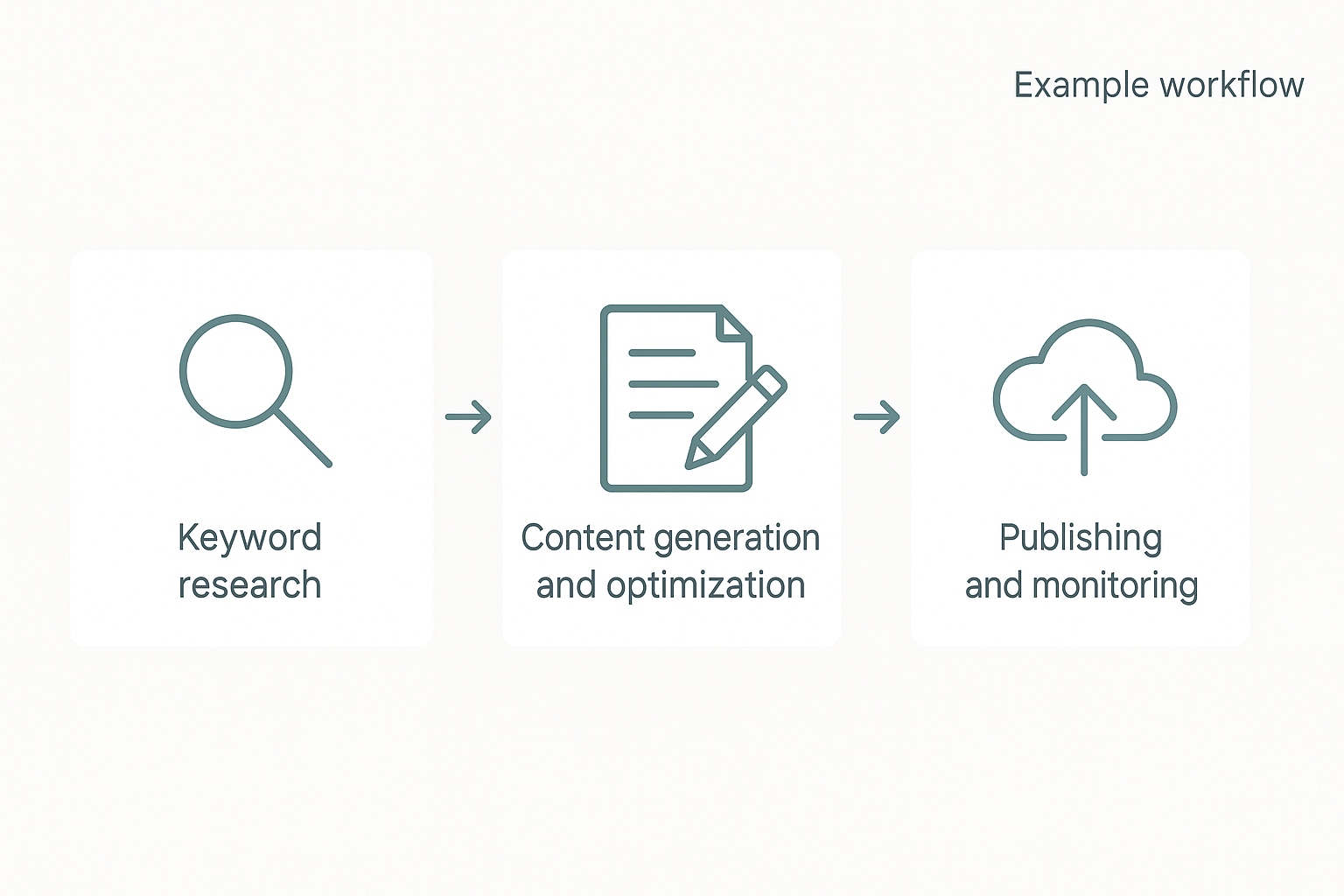
How does it work in short? An automated SEO process usually includes four stages: keyword research, content creation, on-page optimization, and automatic publication. It's worth remembering that AI is not the same as a simple algorithm: algorithms execute defined rules, while AI combines many algorithms and learns from data to optimize decisions (more about the difference you can find here: aproco). AI can speed up personalization and automated content publication (OOH Magazine, Monika Kołodziejczyk), but it is not free of errors and requires human oversight (Dymek, Holistic News). Therefore the best results are achieved when automation and expert control go hand in hand.
What you'll find further in the article
- A practical SEO automation workflow step by step — from keyword research to publication.
- Examples and implementation templates using low-code/no-code tools (e.g. n8n), without technical jargon.
- A quality control checklist and tips on how to supervise AI to avoid errors and risks.
- A brief case analysis showing real time savings and increased visibility.
3. Automating keyword research
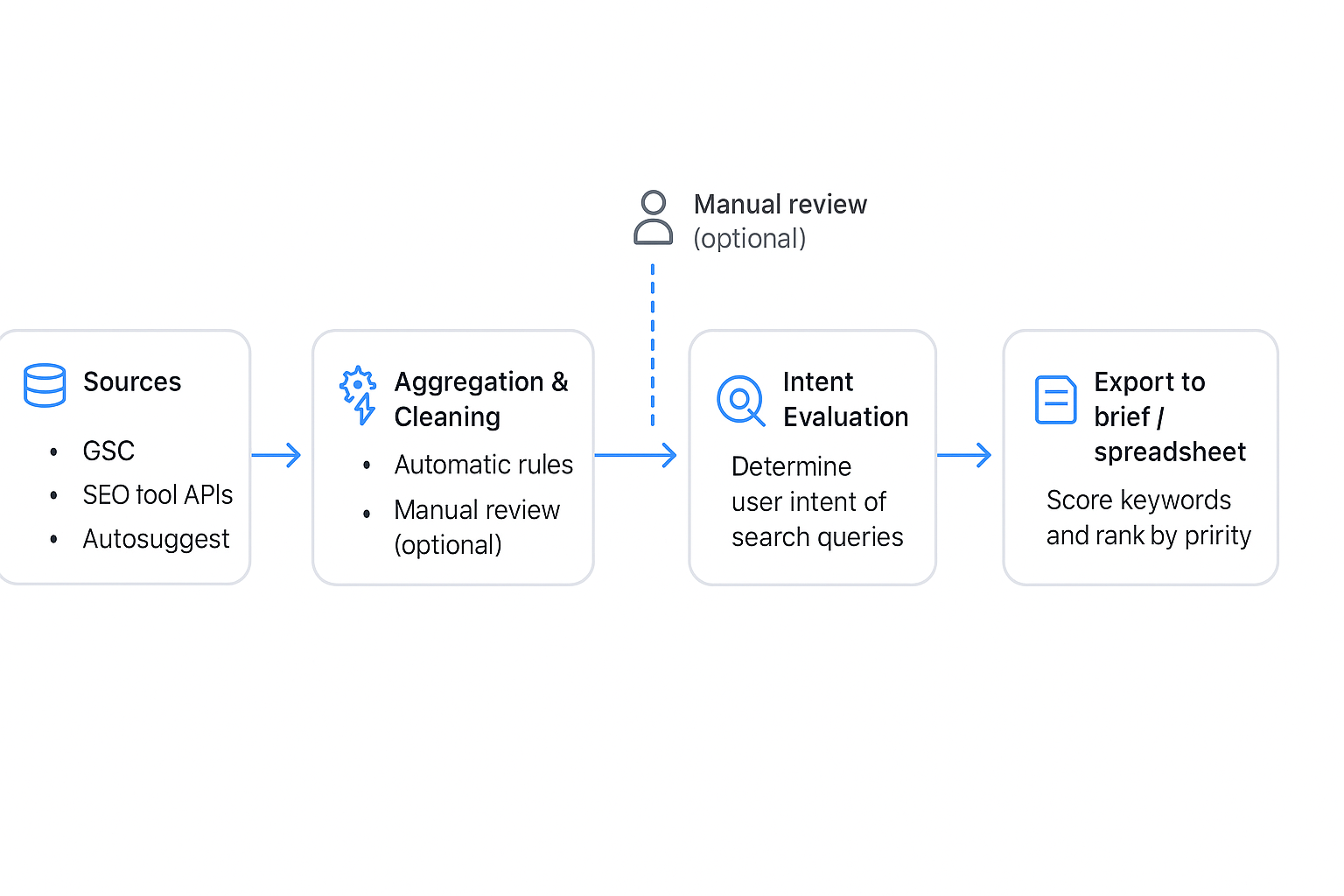
Keyword research is an ideal task for automation — many sources, repetitive actions, and the need for fast filtering. Below you will find a practical, step-by-step guide on how to build a low-code workflow that collects data, cleans it, evaluates intent, and exports a ready list of phrases for further work.
1) Where to source data and how to combine it
- Google Search Console (GSC) — direct user queries, CTR and positions; connect via API.
- Google Keyword Planner — volumes and phrase suggestions (API or CSV export).
- Ahrefs / SEMrush — difficulty (KD), suggestions and competition; integrate via API.
- Google Autosuggest, People Also Ask (PAA) — a source of long-tail terms and questions; collected via scraping or SERP API tools.
- Forums / groups (Reddit, Wykop, industry forums) — real customer needs; scraping topics and questions.
You combine all sources into a single pipeline (e.g. n8n): API calls + periodic scrapers + CSV import → central database (Google Sheets, Airtable, SQL database).
2) Example low-code workflow
- Trigger: scheduled task (cron) — e.g. weekly
- Data aggregation: fetching GSC reports, queries to Ahrefs/SEMrush APIs, request to GKP, scraping PAA/Autosuggest
- Cleaning: removing duplicates, removing stop-words, normalization (lowercase, optional removal of Polish diacritics), trimming
- Intent evaluation: simple rules (phrases with “how”, “in what way” → informational; “buy”, “price” → transactional) or a lightweight classification model (you can use a ready-made classifier in n8n)
- Scoring: assign points for volume, subtract for difficulty (KD), add for conversion potential (transactional words). Example: score = 0.4*norm(volume) - 0.3*norm(KD) + 0.3*conversion_score
- Thematic grouping: clustering based on shared tokens or simple TF-IDF + k-means (low-code tools offer components for this)
- Export: save to Google Sheets / CSV / directly to CMS (e.g. WordPress) with columns: phrase, intent, volume, KD, score, group, recommendation
3) Specifically: automations worth implementing
- Scraping SERP and PAA results every 7 days to catch new questions and snippet opportunities.
- Connecting to Ahrefs/SEMrush/GSC APIs for current volumes, CPC and difficulties.
- Enriching data with CPC and trends (Google Trends API) — important when deciding priorities.
- Automatic selection of “low-hanging fruit”: filter phrases with KD < 30 and score above a threshold (e.g. >0.6) and add them to a quick opportunities list.
4) Human oversight — simple, effective mechanisms
- Validation rules: block branded phrases, phrases not complying with policy, minimum phrase length.
- Alerts for review: send a notification (Slack / e‑mail) for phrases with a very high score or suspicious entries.
- Random quality checks: each week sample 5% of phrases for manual verification and record QC results.
5) Business benefits and KPIs
Automation of research reduces working time from weeks to hours. Example: instead of 40 hours per month on manual research, the workflow may take 5–8 hours of supervision and verification. Monitor KPIs:
- Research time (before/after).
- Number of phrases ready to be developed per month.
- % of traffic coming from new phrases (3–6 months).
- Conversion rate for phrases from the „low‑hanging fruit” list.
Note about AI: automation and models speed up work, but will not replace human oversight. AI may incorrectly assess intent or assign an overly optimistic score — implement validation rules and regular reviews (you can find more about AI limitations, for example, here: aproco.io).
Ready for a pilot? We recommend building the workflow in n8n as an integrator (low-code, flexible) and testing it on a single word segment. If you want, Lumi Zone will implement the pilot — we'll carry out source configuration, scoring and the first round of validation so you can quickly see real time savings and increased efficiency.
5. Automation of content creation, optimization and publishing
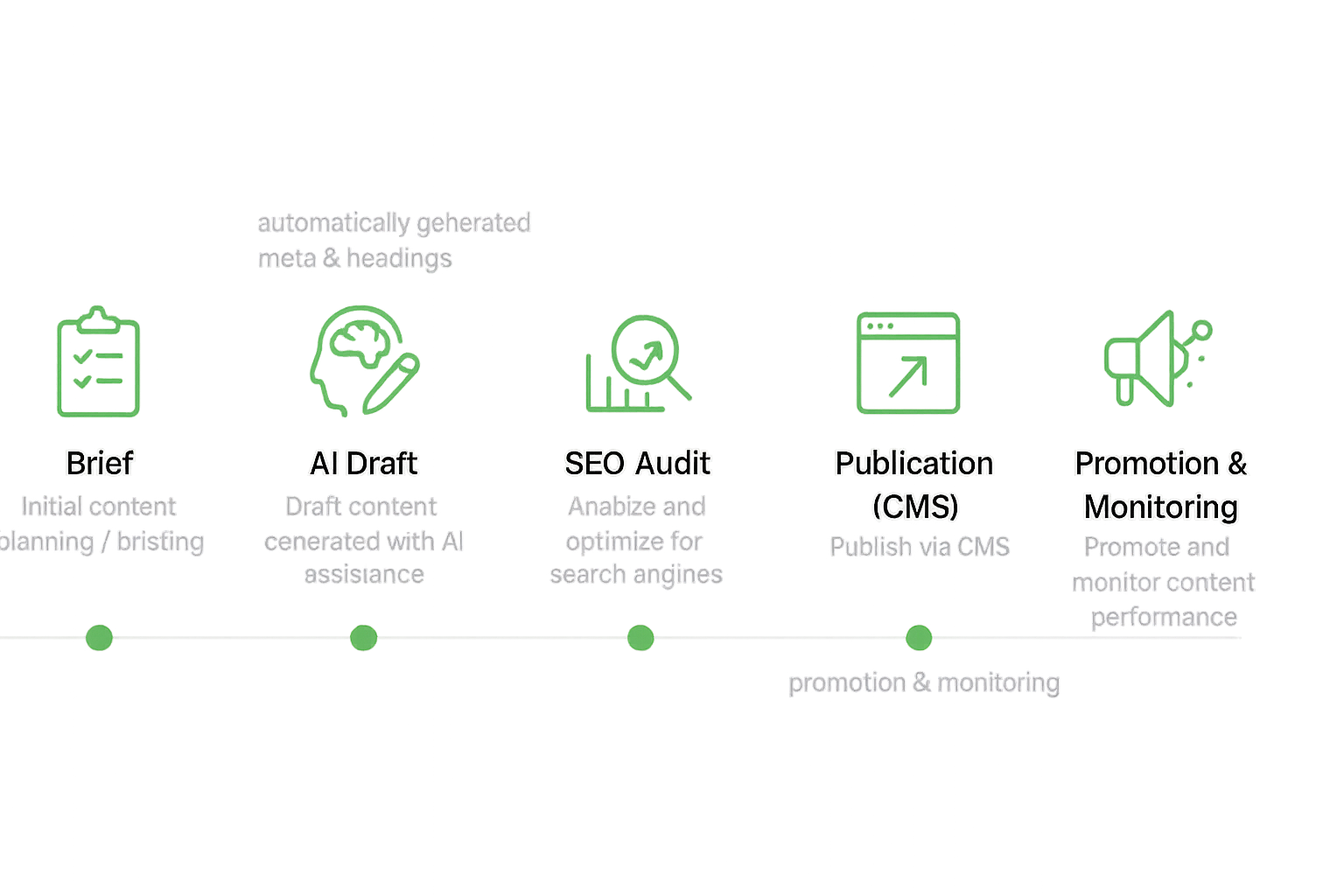
Imagine a pipeline that takes a list of phrases, creates briefs, generates drafts, autonomously optimizes SEO, and finally publishes the post and launches a promotional campaign — with a human as supervisor. Below we describe a complete process «from brief to publication and monitoring», ready to be implemented in a small company or marketing team.
1) Automatic generation of briefs and article structures
- Take a list of keywords (CSV/Google Sheet). An automated script (n8n/Make) creates for each phrase a brief: article goal, target audience, headline suggestions H1–H3, recommended length and tone.
- Prompt template (prompt engineering): „Write a brief for an SEO article for the phrase: [phrase]. Goal: education/conversion. Tone: friendly, expert. Length: 800–1,200 words. Include 4 suggested H2 headings and 2 suggestions for internal links.”
- Length and tone control: the generator returns metadata (word count, recommended style). Automatic rules reject briefs that do not comply with the brand policy.
2) Full content pipeline process
- AI draft generation: based on the approved brief, the model creates a draft of the article with a meta description and a suggested title.
- Automatic SEO check: the tool checks meta tags, header structure, keyword density, image alt texts and suggests internal linking. Errors go into a report with suggested fixes.
- Fact-checking and sources check: the system automatically tags sentences requiring verification, attaches a list of sources to check and aggregates links from the database (tools for checking citations can be connected). According to studies on AI limitations, it's worth having an automatic source verification step (e.g. comparison with trusted domains) — see https://aproco.io/dlaczego-sztuczna-inteligencja-popelnia-bledy-%E2%80%93-i-co-to-oznacza-dla-biznesu.
- Editing by editor: the editor receives the change with a list of SEO recommendations and "verify source" tags. The editor approves or makes corrections.
- Publication to CMS: after approval it goes to WordPress (classic or headless) with automatic meta, JSON-LD schema and sitemap settings. You can enable publication on a specific date or immediately.
- Automatic scheduling in social media and email: the system creates graphics/summaries and schedules posts (Meta, LinkedIn, X) as well as a sequence of promotional emails in the mailing tool.
3) Example workflow in n8n (no-code)
- Trigger: a new row in a CSV/Google Sheets spreadsheet with a phrase.
- Action: generate a briefing (AI node → prompt template).
- Action: generate a draft based on the brief.
- Action: run automatic SEO checks and fact-checking (webhook to SEO tools and source search engines).
- Action: send the task to the editor (email/Slack/Trello) with a checklist.
- Trigger after approval: publish to the CMS via API.
- Final action: share on social channels and schedule the email.
4) Risks and mitigation measures
- AI hallucinations: configure detection of uncertain claims and automatic flagging; enforce verification before publication. Refer to risk analyses (e.g. https://oohmagazine.pl/2023/08/24/sztuczna-inteligencja-a-media-spolecznosciowe/).
- Copyright: automatic scanning of content for plagiarism and checking image licenses.
- Ethics: editorial rules in the pipeline (prohibition on generating medical/legal content without expert verification).
- Quality tests: checklists (plagiarism, factual accuracy, SEO, alt texts). Automated tests before publication and a manual acceptance threshold.
5) Success metrics
- Time to publication: how many days/hours from brief to live.
- Organic traffic for new phrases: increase in sessions and rankings in the SERP after X weeks.
- Conversion rate: leads/purchases attributed to the content.
- CTR in SERP: comparison of titles and meta descriptions A/B.
Example of application: a small service company produces a series of 12 articles for 12 phrases. Traditionally it's a month of editorial work — thanks to Lumi Zone automation the entire cycle (brief, draft, optimization, publication) was completed in a week, while maintaining editorial control and source verification.
Automation will not replace humans — but with a well-designed pipeline it allows the team to focus on value: strategy, verification, and final editing. If you want, Lumi Zone will audit your content process, implement a pilot solution, and train the team — please contact us to jointly build a safe and scalable workflow.
Conclusion and practical checklist + action plan
AI-backed SEO automation is a real opportunity to save time and scale content activities faster. However, the technology alone will not replace human oversight — AI will speed up processes but requires rules, validation, and ongoing monitoring to avoid repeating mistakes or losing quality. If you want SEO to "run by itself", approach it in stages and with clearly defined checkpoints.
7-point action plan
- Process audit: Analyze current SEO workflows — which tasks are routine (meta, scheduling, internal optimization), and which require creative oversight.
- Prioritization: Start with tasks that take the most time and are repetitive (e.g., generating meta descriptions, tagging, scheduling publications).
- 4–6 week pilot: Run a limited pilot on 1–2 measurable areas (e.g., blog + one social channel). Measure results from day one.
- Define success metrics: Set KPIs: time to publish, number of revisions, search rankings, organic traffic, CTR. Measure before and after.
- Set validation rules: Introduce human-in-the-loop: AI confidence thresholds, quality checklists, and automatic alerts for content requiring manual approval.
- Team training: Run short workshops and create a playbook — how to monitor, approve AI suggestions, and correct errors.
- Scaling: After a successful pilot, expand automations to additional areas, iterate rules, and invest in integrations (CMS, analytics tools, publishing tools).
Practical checklist (quick steps)
- Map the 5 most commonly performed SEO tasks.
- Choose 1 area for a pilot (time-consuming, repetitive).
- Define 3–5 KPIs before starting.
- Set validation rules and the person responsible for approvals.
- Plan a 4–6 week pilot and weekly performance reviews.
Estimated resources and realistic ROI expectations
Typical implementation resource set: project owner (1), SEO specialist (0.5–1 FTE or external expert), integrator/automations (1), and access to AI/low‑code tools. Setup and pilot usually take 2–6 weeks. Approximate benefits: time savings on routine tasks around 30–50%, a 2x acceleration of the publishing process, and a reduction in the number of minor corrections by as much as 40–60%. Depending on scale, return on investment is often visible within 3–9 months — with a well-run pilot and clearly measured KPIs.
Call to action — how Lumi Zone can help
Want to check which parts of your SEO should be automated first? Lumi Zone offers a free mini‑audit of your SEO process and a workflow pilot — risk-free, with concrete recommendations and an implementation plan. Contact us via the contact form on the Lumi Zone website or schedule a short call — we'll help plan the pilot and estimate real time savings.
Remember AI limitations and the need for oversight — AI can make mistakes and have a limited understanding of context; it's worth reviewing additional materials: Why AI makes mistakes, AI and social media, Artificial intelligence won't save you, AI in social media — analysis, In the trap of algorithms.