Does AI Effectively Predict Virality? Trend Analysis

Introduction — purpose and context of the article
Virality is the dream of every marketer and small business owner: a single post can bring reach, recognition, and sales at a relatively low cost. At the same time, traditionally virality was difficult to predict — it depended on unpredictable factors, timing, social moods, and… luck. Today AI is changing the game: it can detect content attractiveness signals with high precision by analyzing engagement speed, emotions in comments, or sharing patterns. Important: AI increases the likelihood of success but does not guarantee it.
This article is practical and guide-oriented (about 1,500 words in total). We will show how to use AI tools and automation to detect trends faster, create and optimize campaigns, and implement no-code/low-code processes (e.g., integrations with n8n). As Lumi Zone, we will suggest specific steps and examples you can implement on your own or with our help.
In the following sections we will discuss:
- how AI detects virality signals;
- overview of tools and platforms (including Pressmaster, microtrend monitoring tools);
- how AI supports campaign creation and optimization;
- case studies and real results;
- technical aspects, limitations, and recommendations.
In later parts, we will refer to available research and tools (including Pressmaster and YourDigitalResource), so you receive practical, proven advice.
How AI detects virality signals
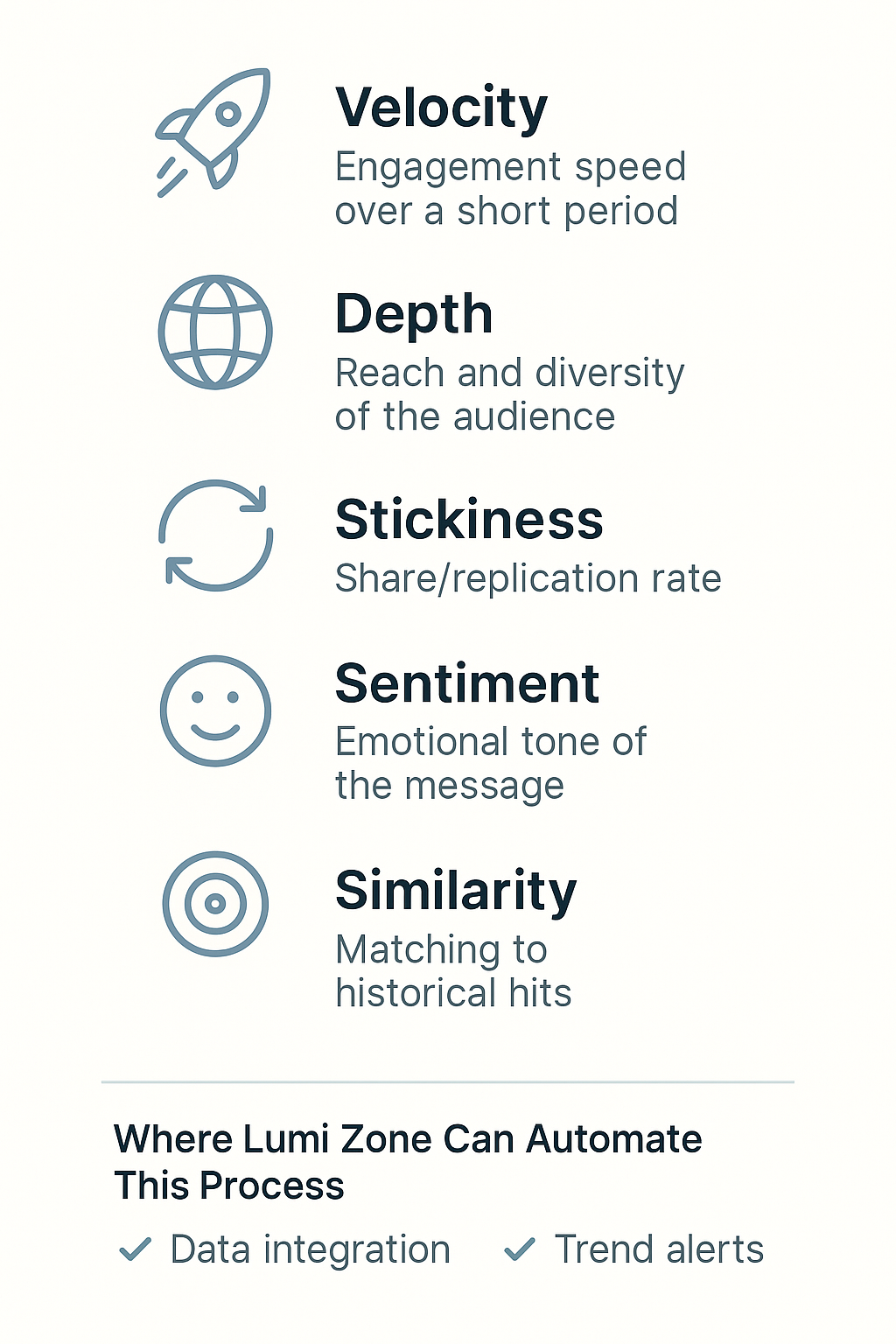
AI recognizes viral potential by analyzing signals from multiple sources simultaneously — it is not a single metric, but a combination of user behaviors and content features. Key data include: number of likes, shares, comments, watch time, and the speed of engagement growth over time. Systems also look at traffic sources: whether content grows in niche communities or engagement comes from influencers — this is often an early signal of an upcoming explosion.
- Velocity — the speed of engagement growth (e.g., a jump in the number of shares in the first hours).
- Depth — the reach depth: how many new, distant groups the content reaches.
- Stickiness — how much the content “sticks” to the audience (repeated plays, comments returning to the thread).
Sentiment analysis and emotion detection is the next level — NLP tools recognize whether reactions are positive, outraged, surprised, or sad. Strong emotions (laughter, anger, surprise) often correlate with a higher tendency to share. In practice, models also compare current signals with historical viral cases: they match thematic patterns, growth rate, and engagement structure to previously successful posts (more practical approaches are described in the article on dev.to: How to predict the next viral video).
What ML methods are used? Without excessive jargon — models trained on examples are used: decision trees and Gradient Boosting handle mixed numerical and categorical data very well, and neural networks are useful for image and audio analysis. These models learn to recognize subtle combinations of features that the human eye might not notice. Ensemble learning — combining several models for better result stability — is also often used.
Key is real-time data integration: a signal that was weak an hour ago may suddenly accelerate — systems that operate with a delay will miss the campaign launch moment. In practice, it is worth monitoring niches and micro-communities, as early “sparks” of virality are born there (more practical observations: AI Predict Social Media Virality).
Limitations are important: randomness, external factors (events, platform policies), and differences between services (YouTube ≠ TikTok ≠ Twitter). AI improves forecast accuracy but does not guarantee it. At Lumi Zone, we combine technology with human experience — we implement systems that detect signals and advise quick actions, while considering risks specific to each platform.
Overview of AI Tools for Trend Forecasting — Comparison of Solutions
Pressmaster AI (Trendmaster)
Pressmaster AI offers the Trendmaster module, which analyzes conversation pace, engagement, and sentiment shifts in real time — the company even declares ~307% improvement in forecast accuracy compared to traditional methods. More details can be found on the manufacturer’s website: Pressmaster – Trendmaster.
- Strengths: fast real-time analysis, sentiment change detection, aggregation of multiple sources.
- User type: content agencies, large brands, growth teams.
- When SaaS: when you need immediate results and ready-made models; when custom: if you want to include private client data or specific KPIs.
Black Swan Data
Black Swan Data specializes in detecting microtrends based on consumer behavior and niche communities.
- Strengths: niche monitoring, microtrend prediction, models based on purchasing behavior.
- User type: FMCG brands, product and research teams.
- When SaaS: for quick market insights; when custom: when integrating sales and CRM data with forecasts.
SparkToro
SparkToro focuses on audience and influencer analysis — helps find where waves of interest are growing.
- Strengths: identification of influential nodes, analysis of communication channels and interests.
- User type: PR teams, influencer marketing, performance agencies.
- When SaaS: best for quick influencer research; custom: when you want to automate collaboration with creators.
Sidetool
Sidetool combines AI with practical creative workflows — details and use cases: Sidetool – Unlock Viral Content.
- Strengths: idea generation, content simulations, integration with publishing tools.
- User type: small content teams, solopreneurs.
- When SaaS: when you want rapid prototyping; custom: when you need deeper tuning to brand voice.
In-house solutions / custom dashboards
Custom dashboards provide full control over data, models can be trained on internal sources (CRM, sales, proprietary metrics).
- Strengths: full integration, private data, customized metrics and alerts.
- User type: organizations with data science teams, regulated companies.
- When to choose: if you need unique KPIs, your own data sources, and full control over the model.
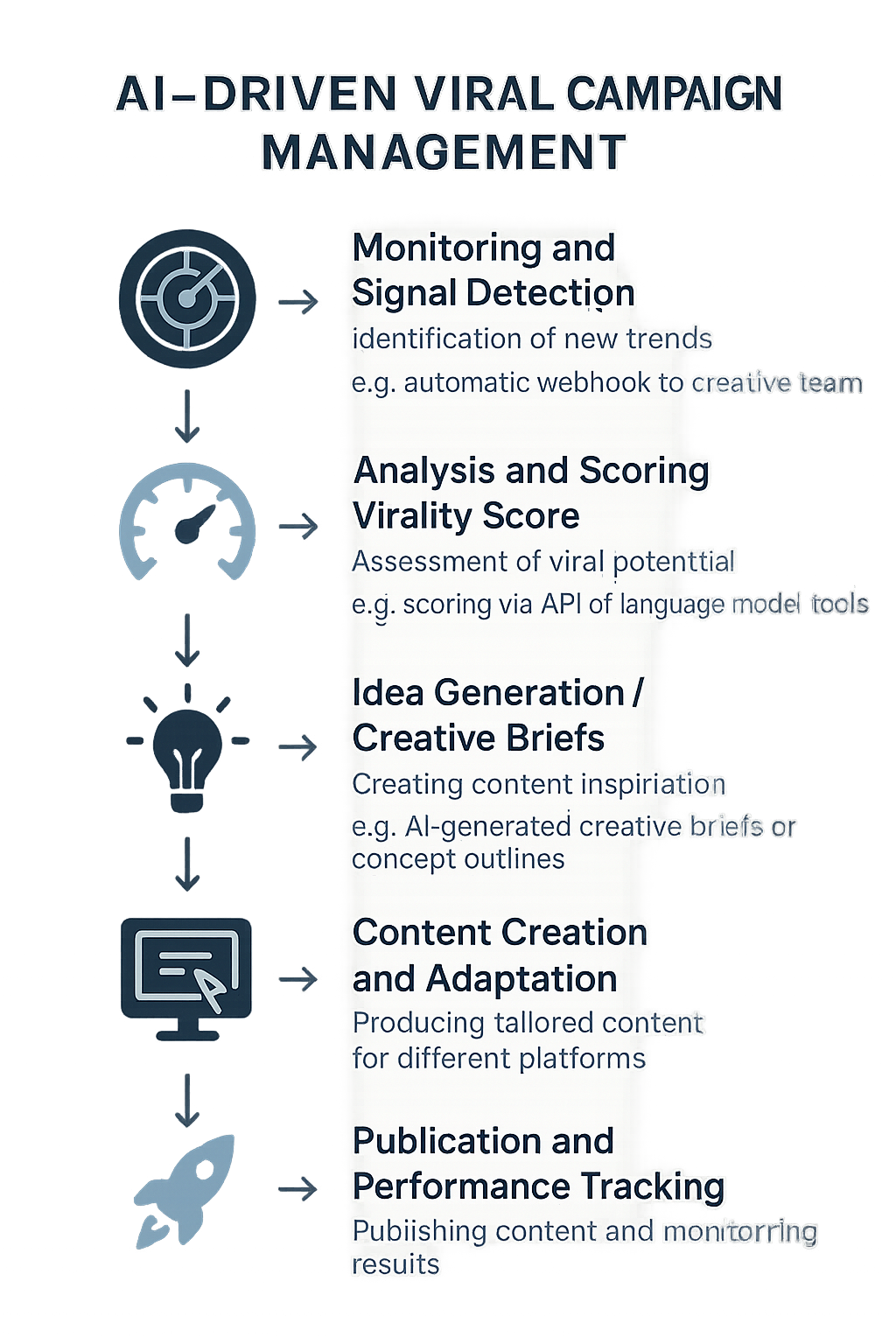
How Lumi Zone can help: we integrate tool APIs (and internal sources), build no-code dashboards and automations in n8n, set up trend alerts and publishing workflows so you can quickly respond to viral opportunities — a perfect solution for companies without a development team. Implementation examples and quick PoCs available on request.
6. Case studies and practical examples
Below you will find 2–3 short, realistic case studies showing how AI and automation practically help detect trends and scale engagement. Examples are anonymized but based on real mechanisms we use at Lumi Zone.
Case 1 — detecting a microtrend on TikTok and quick implementation
AI detected a growing usefulness of a specific sound in a niche group (microtrend). Within 48 hours, we prepared a series of 8 short videos and invited 6 micro-influencers to distribute them.
- Organic reach increased by 380% in 7 days
- Average watch-through rate improved by 18 percentage points
- Shares x4, engagement +220%
- Role of AI: early signal detection, automatic creative briefs, and influencer selection
Case 2 — content simulation and "hook" optimization
Before publishing, AI simulated a dozen variants of opening lines (hooks) and assessed their potential. We selected the top 3 for A/B testing.
- CTR increased from 1.1% to 3.5% (x3)
- Average watch time +42%
- Shares +180%
- Role of AI: variant generation, CTR prediction, automatic A/B reports
Case when AI predicted success, but the campaign did not explode
AI indicated high potential, but the campaign stalled due to a sudden platform policy change and cancellation of cooperation with a key creator. Conclusion: the model provided valuable signals, but external factors and randomness affect the final result.
Want to delve into the methodology? Useful sources: How AI predicts social media virality, predict the next viral video (technical).
Practical checklist — 5 steps to test AI in your brand
- Define one KPI (reach, CTR, shares) and note the baseline.
- Choose a small test segment and set the experiment budget.
- Use AI to generate and simulate 5–10 content variants.
- Implement real-time monitoring and automatic scaling on the best-performing variants.
- Analyze results, draw conclusions, and update the model/creative brief.
If you want to test similar scenarios quickly and risk-free, Lumi Zone will help implement automation, tool selection, and conduct a pilot.
Summary and call to action
AI significantly increases the chances of identifying content with viral potential, but does not provide a 100% guarantee — fast decisions and efficient automation are key. Tools detect signals (velocity, stickiness, sentiment), but it is the rapid launch of the campaign and real-time optimization that determine success.
- Download and normalize historical data from platforms: engagement, watch time, shares.
- Choose a tool based on criteria: integrations, access to models, no-code capabilities, and data export.
- Start a pilot (PoC) on one channel — test A/B, “hooks” and formats quickly and cheaply.
- Define success metrics: virality score, velocity, CTR, number of shares, and conversions.
- Automate trend monitoring, alerts, and dashboards (e.g., workflow in n8n) before scaling.
Want to start without risk? Lumi Zone offers a campaign automation readiness audit: trend monitoring, n8n/no-code integration, dedicated dashboards, and proof-of-concept for one channel. Schedule a free consultation or download our checklist/report to quickly verify your idea. Write to: hello@lumizone.pl or fill out the form: https://lumizone.pl/kontakt.