The biggest time-wasters in a company and how AI eliminates them

Introduction — purpose and promise of the article
Did you know that companies lose up to 30% of working time to repetitive, manual tasks? In this short series we'll identify the most common "time thieves" in a company and show how AI and automation solve them in a fraction of the time — often in seconds.
In simple terms: algorithms are predictable sequences of instructions operating according to clearly defined rules, whereas AI uses algorithms but additionally learns from data and can adapt its decisions to context. It is this adaptation that makes automation in social media or customer service deliver real benefits — personalization, faster reports and automatic responses.
Later on you will find: a list of problems, process visualizations, practical solutions and a step-by-step implementation with Lumi Zone (we specialize in low-code/no-code solutions, including n8n). You will read specifics that will save you time and resources.
Further reading: Why AI Makes Mistakes, AI and social media, Criticism of AI, AI in content creation, In the algorithm trap.
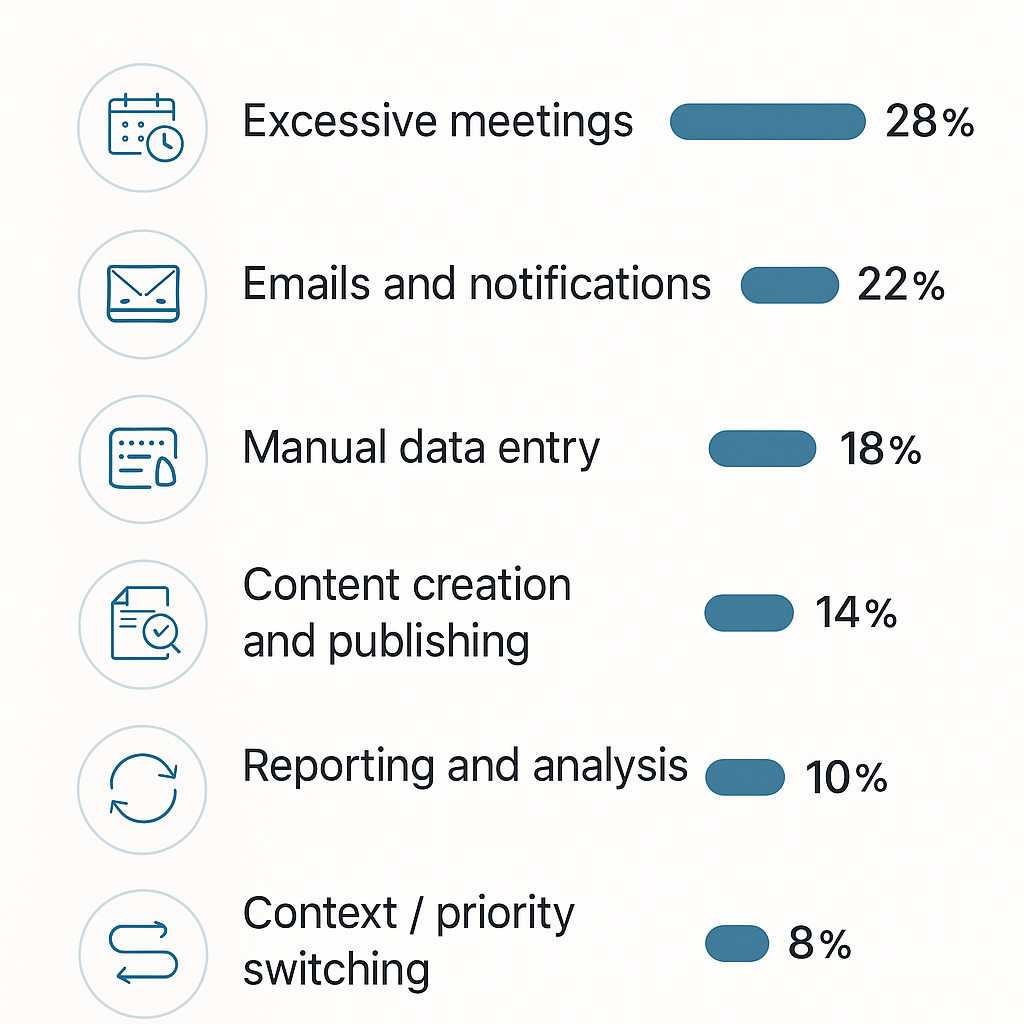
Detailed overview of the main "time thieves"
Below we describe six of the most common problems that eat up the time of teams in small companies. For each item we explain why the problem arises, give concrete examples, a short anecdote from the life of a small company and estimated savings that automation and AI provide (while noting the limitations of the technology — you can read more about the difference between algorithms and AI and the risks of errors in further reading).
1. Too long and inefficient meetings
Why: no agenda, too many participants, no decisions at the end. Examples: weekly meetings that drag on without concrete tasks; status updates that can be exchanged asynchronously.
Anecdote: in an 8-person marketing team a weekly meeting lasts 90 minutes instead of the planned 45 — that's 8 hours lost per week. Savings: introducing short stand-ups + automatic notes reduces time by 30–50%.
2. Inbox overload — e-mails
Why: excess notifications, lack of filtering rules, manually responding to repetitive inquiries. Example: customer service forwards inquiries from the form to a general inbox where priorities get lost.
Anecdote: a shop owner spends an hour a day sorting emails — rule automation and templates reduce this to 15 minutes. Savings: 50–75% of time.
3. Manual data entry
Why: lack of integration between systems, copy-paste, manual CRM updates. Examples: marketing manually publishes posts; sales enters leads into the CRM after a call.
Anecdote: a sales representative spends 2 hours weekly updating the CRM — automatic data transfer and forms reduce this to 15 min. Savings: 70–90% of time, fewer errors.
4. Content creation
Why: pressure to publish frequently, lack of tools for drafts and scheduling. Examples: manually planning posts, separate graphics and copy created in multiple applications.
Anecdote: a solo content manager loses days preparing a weekly calendar — AI generating drafts and schedules halves the process. Savings: 40–70% of time (more about automation in social media: article, analysis).
5. Reporting
Why: manual collection of data from multiple sources, spreadsheet updates, creating presentations. Example: monthly sales reports prepared manually.
Anecdote: in a small agency preparing a report takes 2 days — automated dashboards shorten the process to hours. Savings: 80–95% of time and faster business decisions.
6. Context switching (context switching)
Why: working on multiple tasks at once, lack of priorities and too many tools. Consequences: productivity drop of even 20–40% with frequent switching.
Anecdote: a developer interrupted by notifications loses dozens of minutes a day — configured work schedules and automated notifications reduce downtime. Savings: 25–50% of recovered productivity.
In practice, combining simple algorithms with AI (with human oversight) yields the greatest effects: it eliminates routine, personalizes processes and shortens operational time. If you want to calculate potential savings in your company, Lumi Zone will help implement a solution tailored to your needs — taking into account AI benefits and limitations (more on the risks of errors: read).
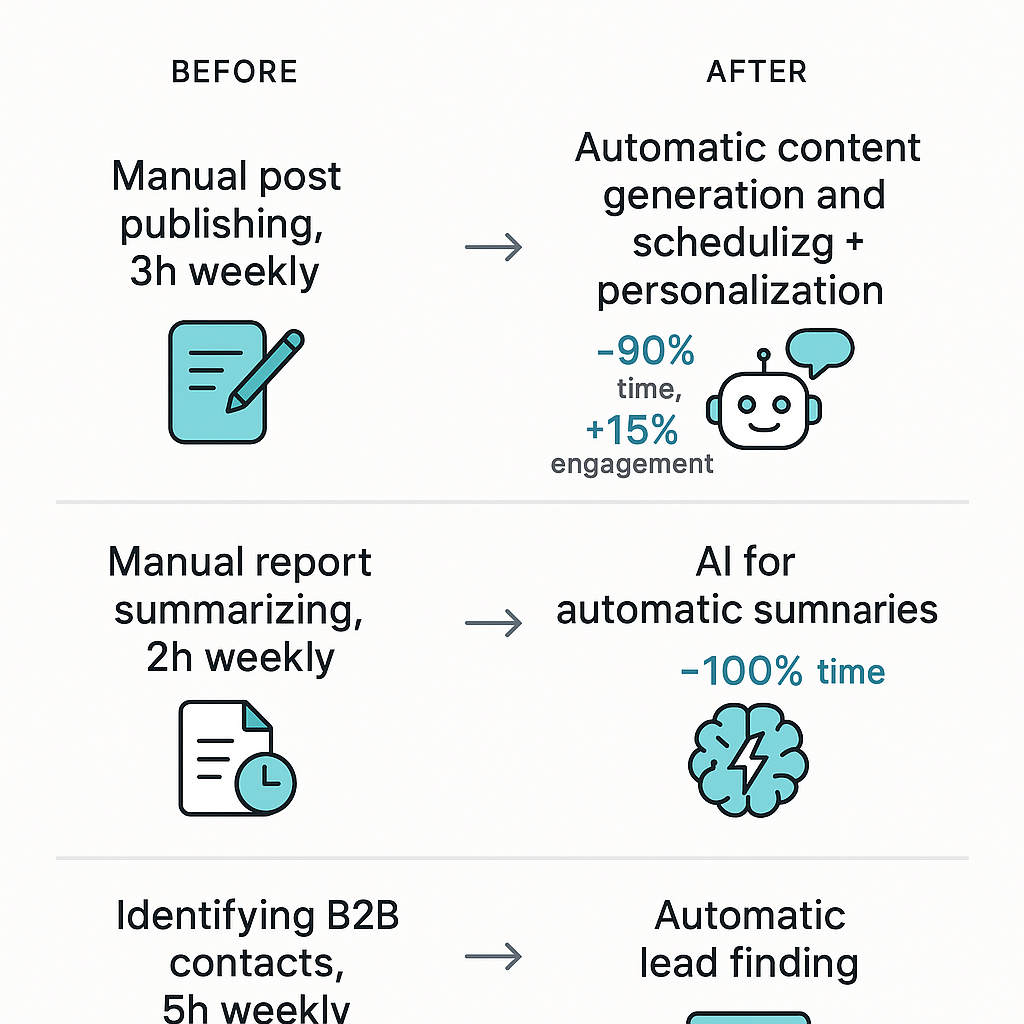
5. How AI and automation solve every problem — a practical guide to solutions and use-case examples
Here you'll find real, step-by-step ideas for implementation — from simple automations to complex low-code/no-code systems. We focus on concrete solutions for the most common "time-wasters" in a company and show how Lumi Zone helps conduct an audit, run a pilot, and train the team.
Concrete solutions for common time-wasters
- Social media — automatic scheduling and content generation: AI creates post proposals (topic, copy, suggested graphic), n8n or publishing tools (Buffer, Meta Scheduler) automatically post content at optimal times. Manual edits are limited to final approval.
- Message handling and FAQ — customer service bots: Chatbots (Messenger, WhatsApp, webchat) answer repetitive questions, triage issues, and forward only complex cases to the team. This reduces support load by 40–60%.
- Lead capture & CRM — integration of forms and data mapping via n8n: Online form → n8n transforms and maps fields → CRM (HubSpot, Pipedrive) → automatic owner assignment and email sequence. Zero manual retyping.
- Reports and dashboards — automatic reporting: Data from Google Analytics, sales, and CRM goes into a single dashboard (Looker Studio/Power BI). n8n or an ETL move the data and schedule updates, sending daily/weekly reports to the team.
Sample workflows (description of 3–4 ready-made processes)
Workflow A — Social content pipeline (quick implementation)
- AI generates 14 post proposals per month (topics, CTAs, hashtags).
- The moderator approves 7 of them; AI fine-tunes tone and length.
- n8n sends the approved posts to the publishing tool and sets the schedule.
- After publishing, AI analyzes reach and suggests optimizations for the next week.
Tools: content generation model, n8n, Buffer/Meta Scheduler, Google Sheets/Looker Studio.
Workflow B — Form → CRM → Onboarding
- The customer fills out the form (Typeform/Google Forms).
- n8n maps fields, normalizes data, and creates a record in the CRM.
- Automatic email sequence + assignment of a sales task.
- The system reports lead→opportunity conversion daily.
Tools: Typeform, n8n, HubSpot/Pipedrive, Gmail/SendGrid.
Workflow C — Bot triage + ticketing
- The bot receives the submission, asks key questions, and classifies the problem.
- If simple — the bot resolves automatically; if complex — it creates a ticket in the helpdesk system and marks the priority.
- The agent receives prepared context (history, attachments), shortening the resolution time.
Tools: Chatbot platform, n8n, Zendesk/HelpScout.
Short case studies and estimated ROI
- Small e‑commerce: automatic scheduling of posts + FAQ bot → savings of 10 h per week (~50% of social/support time). Estimated ROI: payback in 3–6 months due to higher conversion and lower support costs.
- B2B with manual lead handling: integration of forms with CRM via n8n → reduced errors and 30% faster responses to leads → conversion increase of 12–18%.
- Marketing agency: automated reports → savings of 8 h per month per client; ability to handle more campaigns without increasing the team.
Limitations and risks — what you need to know
- Data quality is crucial — AI replicates errors if sources are bad. Read the analysis: Why AI makes mistakes.
- AI does not understand cultural context or moral nuances — it requires human oversight (content moderation, final approval).
- The risk of “patterns” and algorithmic limitations — it's worth familiarizing yourself with critical voices on the subject: In the trap of algorithms and AI in social media.
Role of Lumi Zone — how we support implementation
Lumi Zone carries out the full process: process audit, solution design, pilot implementation in a low-code/no-code model (e.g. n8n), and then training and knowledge transfer. We work in stages to minimize risk and quickly deliver value.
Sample 30/60/90-day implementation plan
- Days 0–30: process audit, prioritization, quick automations (social scheduler, forms → CRM), pilot preparation.
- Days 31–60: building and testing workflows (n8n), integrations, initial team training, KPI monitoring.
- Days 61–90: scaling solutions, automated reports and dashboards, optimization, final training and documentation, and ROI analysis.
Would you like us to design a pilot tailored to your company? Lumi Zone will prepare an audit and a 30/60/90-day plan — contact us and we'll show concrete time savings and efficiency gains.
Further reading: Aproco — AI errors, Monika Kołodziejczyk — AI in social media, Holistic — algorithm traps.
Summary and call to action
The biggest time thieves in a company are repetitive manual tasks, fragmented processes and lack of tool integration — they steal hours, increase errors and waste resources. With AI-based automation and low-code/no-code tools (e.g. n8n) you can reclaim that time, increase team efficiency and make better use of your marketing budget. Lumi Zone helps turn these benefits into concrete results: faster processes, fewer errors, better personalization of communication and measurable savings.
What you can do now — three simple steps:
- Free process audit — we will map key processes free of charge, identify bottlenecks, propose concrete automations (n8n, no-code) and estimate potential time savings and an indicative ROI.
- 30-day pilot — we implement one, most important automation, measure KPIs (time, errors, engagement), iterate and train the team so you can see real results without risk.
- Scalable implementation — we plan a phased rollout, monitor results, provide support and the possibility to expand solutions as the company grows.
After contact you will receive a detailed analysis, an ROI proposal and an implementation offer tailored to your needs. Want to stop wasting time and start saving resources? Contact Lumi Zone — we’ll respond quickly and show how automation will pay off in practice.
Sources and further reading
- https://aproco.io/dlaczego-sztuczna-inteligencja-popelnia-bledy-%E2%80%93-i-co-to-oznacza-dla-biznesu
- https://oohmagazine.pl/2023/08/24/sztuczna-inteligencja-a-media-spolecznosciowe/
- https://dymek.substack.com/p/sztuczna-inteligencja-was-nie-uratuje
- https://monikakolodziejczyk.pl/sztuczna-inteligencja-w-social-media-jak-ai-rewolucjonizuje-tworzenie-i-analize-tresci/