Virtual Receptionist 24/7 – How Voicebot Answers Phones and Saves Your Team's Time

Revolution in Customer Service
In today's fast-paced business environment, effective customer communication is paramount. However, traditional phone service models often present significant challenges. Businesses grapple with the high costs associated with staffing a full-time reception team, especially for 24/7 availability. Missed calls, long hold times, and inconsistent service delivery can lead to frustrated customers and lost opportunities. The operational overhead of managing inbound calls distracts valuable human resources from more strategic tasks, impacting overall productivity and profitability.
The imperative for automation in customer service has never been clearer. Companies are actively seeking innovative solutions to streamline operations, reduce expenses, and elevate the customer experience. This is where the virtual AI receptionist emerges as a transformative technology. Unlike conventional answering services, a virtual AI receptionist leverages advanced artificial intelligence to handle inbound calls with intelligence, efficiency, and consistency, around the clock.
Imagine a system that greets every caller professionally, understands their intent, provides accurate information, and routes them to the correct department or individual, all without human intervention unless truly necessary. This is the promise of an AI-powered virtual receptionist: a solution designed to overcome the inherent limitations of traditional phone systems, ushering in an era of intelligent automation that redefines customer engagement and operational efficiency.
This article explores how voicebot technology is revolutionizing call handling, freeing up your team's time, and providing a superior customer experience 24/7. It's not just about answering calls; it's about smart, scalable, and cost-effective communication.

What is a Virtual AI Receptionist?
A virtual AI receptionist, often referred to as a voicebot or AI voice assistant, is an intelligent software system designed to interact with callers using spoken language. It functions as an automated agent capable of understanding, processing, and responding to natural human speech, much like a human receptionist but with unparalleled speed and availability. At its core, this technology combines two critical AI components: speech recognition and Natural Language Processing (NLP).
Speech recognition is the foundational technology that allows the voicebot to convert spoken words into text. When a caller speaks, the audio signal is analyzed and transcribed, enabling the AI to comprehend what is being said. This process has become remarkably accurate in recent years, thanks to advancements in deep learning and vast datasets. High-quality speech recognition is essential for the voicebot to accurately interpret caller queries, regardless of accents or speech patterns.
Once the spoken words are converted into text, Natural Language Processing (NLP) takes over. NLP is a branch of AI that enables computers to understand, interpret, and generate human language in a way that is both meaningful and contextually appropriate. For a virtual receptionist, NLP allows it to:
- Understand intent: Determine the caller's primary goal or question (e.g., "I need to schedule an appointment," "What are your business hours?").
- Extract entities: Identify key pieces of information within the conversation, such as dates, times, names, or product codes.
- Manage dialogue: Maintain a coherent conversation flow, asking clarifying questions when needed and remembering previous interactions.
- Generate responses: Formulate relevant and natural-sounding verbal replies or retrieve information from databases to answer queries.
Together, speech recognition and NLP empower the voicebot to handle a wide range of tasks, from answering frequently asked questions and providing detailed information to processing basic transactions and intelligently routing calls. Unlike traditional Interactive Voice Response (IVR) systems that rely on rigid menu trees and button presses, a virtual AI receptionist offers a more fluid, conversational experience, mimicking human interaction and significantly improving caller satisfaction.
A virtual AI receptionist combines advanced speech recognition and Natural Language Processing to understand and respond to human speech, transforming the traditional call handling experience into a fluid, intelligent conversation.

How Does a Virtual Receptionist Work? Step-by-Step Process
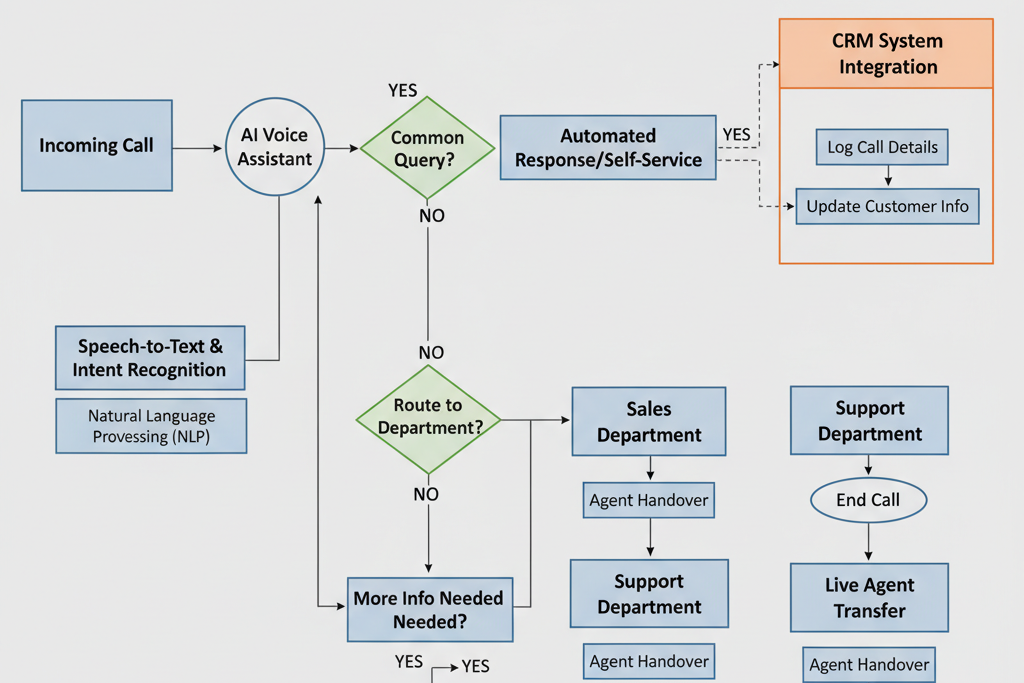
Implementing a virtual AI receptionist transforms the inbound call experience through a structured, intelligent process. This step-by-step breakdown illustrates how a voicebot seamlessly manages calls from initial greeting to resolution or intelligent transfer.
1. Call Answering and Initial Greeting
The moment an incoming call is detected, the virtual receptionist answers instantly. It delivers a pre-programmed, professional greeting, often customized with the company name, such as "Thank you for calling [Company Name]. How may I assist you today?" This immediate response eliminates hold times, setting a positive tone for the caller's experience.
2. Speech Recognition and Intent Analysis
Following the greeting, the voicebot activates its speech recognition engine to convert the caller's spoken query into text. Simultaneously, its Natural Language Processing (NLP) capabilities analyze this text to understand the caller's intent. For example, if a caller states, "I'd like to check the status of my order," the NLP identifies "check order status" as the primary intent.
3. Information Retrieval and Dialogue Management
Once the intent is clear, the virtual receptionist accesses relevant databases or CRM systems to retrieve necessary information. If the query is straightforward (e.g., "What are your business hours?"), the voicebot can provide the answer directly and verbally. For more complex requests, it engages in a natural dialogue, asking clarifying questions like, "Could you please provide your order number?" to gather specific details. This dialogue management ensures the conversation progresses efficiently and gathers all required data.
4. Intelligent Call Routing or Self-Service Resolution
Based on the analyzed intent and collected information, the voicebot makes an intelligent decision. If the query can be resolved through self-service (e.g., providing an FAQ answer, confirming an appointment, or updating basic information), it guides the caller through the process to achieve resolution without human intervention. This significantly reduces the workload on human agents.
However, if the request requires human expertise—for instance, a complex technical support issue or a sales inquiry that demands negotiation—the virtual receptionist intelligently routes the call to the most appropriate department or individual. This routing can be based on predefined rules, agent availability, caller history, or the urgency of the request. The voicebot can also provide context to the human agent before the transfer, ensuring a smooth handoff and preventing the caller from having to repeat themselves.
5. Post-Call Actions and Data Logging
After each interaction, whether resolved by the bot or transferred, the virtual receptionist logs all relevant data. This includes the caller's intent, the information exchanged, the resolution pathway, and any feedback provided. This data is invaluable for analytics, allowing businesses to identify common issues, improve service workflows, and continuously train the AI model for enhanced performance. The voicebot also ensures that any necessary follow-up actions, such as sending an email confirmation or updating a CRM record, are triggered automatically.
This systematic approach ensures that every call is handled consistently, efficiently, and intelligently, providing a superior experience for the customer while optimizing operational resources.
5 Key Benefits for Your Company
Implementing a virtual AI receptionist offers a multitude of strategic advantages that directly translate into improved operational efficiency, reduced costs, and enhanced customer satisfaction. Here are five key benefits that make voicebot technology a compelling investment for any forward-thinking business:
1. Significant Time Savings for Your Team
One of the most immediate and impactful benefits is the substantial time savings for your human team. By automating routine inquiries, frequently asked questions, and basic information dissemination, the virtual receptionist frees up your employees from repetitive tasks. This allows skilled staff to focus on complex cases, strategic initiatives, or direct customer interactions that genuinely require human empathy and problem-solving. Businesses often report a reduction of up to 40% in call handling time for common queries, translating into hundreds of hours saved annually across departments.
2. Substantial Cost Reduction
The financial implications of a virtual AI receptionist are considerable. Traditional reception services, especially those offering extended hours, incur significant labor costs, including salaries, benefits, training, and infrastructure. A voicebot operates without these overheads. It can handle an unlimited volume of calls concurrently, eliminating the need for additional staff during peak periods or for 24/7 coverage. This can lead to cost savings of 50-70% compared to hiring and maintaining a human reception team, providing a rapid return on investment (ROI).
3. Uninterrupted 24/7 Availability
Customer needs do not adhere to standard business hours. A virtual AI receptionist provides continuous, round-the-clock service, 365 days a year. This constant availability ensures that customers can always get their questions answered, schedule appointments, or resolve urgent issues, regardless of time zones or public holidays. Such uninterrupted service significantly improves customer satisfaction and prevents lost business opportunities that might arise from unanswered calls during off-hours. Companies leveraging 24/7 AI support often see an increase in lead generation and customer loyalty.
By automating routine inquiries and providing 24/7 availability, a virtual AI receptionist can reduce call handling time by up to 40% and overall operational costs by 50-70%, ensuring no customer query goes unanswered.
4. Dramatically Improved Customer Service Experience
The consistency, speed, and accuracy of a virtual AI receptionist elevate the overall customer service experience. Callers receive immediate attention, accurate information, and efficient resolution to their queries. Unlike human agents who might experience fatigue or varying moods, a voicebot provides a consistently polite and professional interaction every time. Furthermore, its ability to quickly access and synthesize vast amounts of data means callers receive precise answers without being put on hold indefinitely. This leads to higher customer satisfaction scores and a stronger brand reputation.
5. Scalability to Meet Any Demand
Business growth often brings increased call volumes, which can quickly overwhelm human reception teams. A virtual AI receptionist offers unparalleled scalability. It can effortlessly handle sudden spikes in call volume during promotional periods, product launches, or seasonal demands without any degradation in performance or the need for additional hiring. This elasticity ensures that your customer service infrastructure can grow and adapt with your business, providing a consistent level of service no matter the scale of operations. Whether you have 100 calls a day or 10,000, the voicebot maintains peak efficiency.

Usage Examples in Various Industries
The versatility of a virtual AI receptionist allows its effective deployment across a wide spectrum of industries, each benefiting from its ability to streamline operations and enhance customer interactions. Here are specific use cases demonstrating its broad applicability:
Service Industry: Enhancing Client Engagement
In the service industry, encompassing sectors like salons, spas, fitness centers, and repair shops, the virtual receptionist excels at managing appointments and providing quick information. It can automatically schedule, reschedule, or cancel appointments, send reminders, and answer common questions about services, pricing, and operating hours. For example, a hair salon's voicebot can confirm bookings, inform clients about stylist availability, or even direct them to online portfolios, significantly reducing the administrative burden on staff and ensuring clients receive immediate, accurate assistance.
Medical Sector: Streamlining Patient Access
For medical practices, clinics, and hospitals, a virtual AI receptionist can revolutionize patient communication. It can handle appointment scheduling, provide directions to facilities, answer questions about visiting hours, clarify pre-appointment instructions, and even guide patients through basic symptom screening for non-emergency situations. This automation alleviates the pressure on front-desk staff, allows nurses to focus on patient care, and ensures patients receive critical information promptly and accurately, improving overall patient experience and operational flow.
E-commerce: Supporting Online Shoppers
E-commerce businesses frequently face high volumes of customer inquiries related to order status, shipping details, product information, and return policies. A virtual receptionist can handle these queries efficiently, providing instant updates on tracking numbers, explaining return processes, or detailing product specifications directly from the online catalog. This self-service capability reduces cart abandonment rates by providing immediate answers to purchasing questions and frees up human customer support agents to handle more complex issues like dispute resolution or personalized product recommendations.
Consulting and Professional Services: Optimizing Client Inquiries
For consulting firms, legal practices, accounting services, and other professional service providers, the virtual receptionist can act as a sophisticated first point of contact. It can qualify leads by asking preliminary questions about a client's needs, explain service offerings, collect necessary documentation, and schedule initial consultations with the appropriate expert. This pre-screening process ensures that human consultants spend their time only with genuinely interested and qualified prospects, optimizing their workflow and enhancing the client acquisition process. It also provides 24/7 access for potential clients, capturing leads outside business hours.
These examples illustrate that regardless of the industry, a virtual AI receptionist serves as an invaluable asset, driving efficiency, enhancing customer satisfaction, and allowing businesses to scale their communication capabilities without compromising quality.
How to Implement Virtual Receptionist with Lumi Zone
Implementing a virtual AI receptionist with Lumi Zone is a streamlined, client-centric process designed to deliver a tailored, effective, and stable system. Our approach prioritizes your unique business needs, ensuring the AI solution integrates seamlessly with your existing operations without unnecessary complexity or hidden costs.
1. Initial Consultation and Needs Assessment
The process begins with a comprehensive consultation to understand your current call handling challenges, specific business objectives, and desired outcomes. We analyze your typical call volumes, common customer inquiries, peak hours, and existing communication infrastructure. This deep dive allows us to define the scope and specific functionalities required for your virtual receptionist, ensuring the solution is perfectly aligned with your operational goals.
2. AI Model Training and Personalization
Based on the needs assessment, we initiate the AI model training. This involves feeding the voicebot relevant data, including FAQs, scripts for common scenarios, product information, and service details specific to your business. We focus on training the Natural Language Processing (NLP) model to accurately understand your customers' language, jargon, and intent. The voicebot's tone, personality, and response patterns are personalized to reflect your brand's voice, creating a consistent and professional caller experience.
3. Configuration and Workflow Design
Our experts then configure the virtual receptionist's workflow, mapping out the step-by-step call handling process. This includes defining call routing logic (e.g., direct transfers to specific departments based on intent), integrating with your appointment scheduling systems, and setting up data retrieval mechanisms from your databases. We ensure the system intelligently navigates caller requests, providing accurate information or transferring calls only when human intervention is truly necessary.
4. Seamless CRM and System Integration
A core strength of Lumi Zone's approach is our ability to integrate the virtual receptionist with your existing customer systems. We build robust connections with your CRM (Customer Relationship Management) system, ensuring that caller data is automatically logged, updated, and accessible to your human agents. This integration extends to other vital tools such as calendar applications, ERP systems, or internal knowledge bases, creating a unified and efficient operational ecosystem. Our commitment to independence means we select technologies that best solve your problem, not those tied to specific partnerships.
5. Testing, Deployment, and Continuous Optimization
Before full deployment, the virtual receptionist undergoes rigorous testing across various scenarios to ensure accuracy, reliability, and a smooth user experience. We conduct pilot tests with real-world calls and gather feedback. Once optimized, the system is deployed. Lumi Zone doesn't stop there; we offer continuous monitoring and optimization. As call patterns evolve or new services are introduced, we retrain the AI model and refine the workflows to maintain peak performance, ensuring your virtual receptionist remains a cutting-edge asset. Our mission is to deliver simple, effective, and stable systems.
