SEO vs RAO: Which Strategy Will Survive the AI Era in Search Engines?

Introduction: Navigating the Shift from SEO to RAO in 2025
\nAs we move deeper into 2025, artificial intelligence is reshaping the landscape of search engines more profoundly than ever before. Traditional search methods are no longer the sole path to visibility online—AI-driven technologies now dominate, transforming how users find and interact with content. This shift is compelling digital marketers, businesses, and content creators to rethink their strategies radically. That’s where the comparison between classic Search Engine Optimization (SEO) and the emerging RAO (AI-Optimized Search, also known as AI-Enhanced Optimization or AEO) becomes crucial.
\nFor years, SEO has been the backbone of organic search, relying on optimizing keywords, backlinks, and technical factors to rank websites effectively. However, the surge of AI in search engines is changing user behavior—searches are becoming more conversational, context-rich, and personalized. Today, search engines don’t just look for keywords; they strive to understand intent, predict needs, and deliver answers instantly. This means that RAO comprehensively tailors content by leveraging artificial intelligence to interpret nuances in language and individual user contexts far beyond traditional SEO capabilities.
\nUnderstanding this evolution is essential because 2025 marks a pivotal year: voice searches, AI assistants, and personalized queries are no longer trends but expected standards. Gone are the days when stuffing a page with keywords guaranteed success. Instead, the ability to align content with AI’s interpretation of user intent determines your visibility and relevance.
\nIn this article, we’ll delve into how SEO and RAO differ fundamentally, why RAO stands out in the AI era, and how combining both approaches can position your digital presence for success. Whether you’re a seasoned marketer or an entrepreneur navigating the dynamic digital world, grasping this shift will help you stay ahead in the increasingly complex ecosystem of search engines influenced by artificial intelligence.
\n\n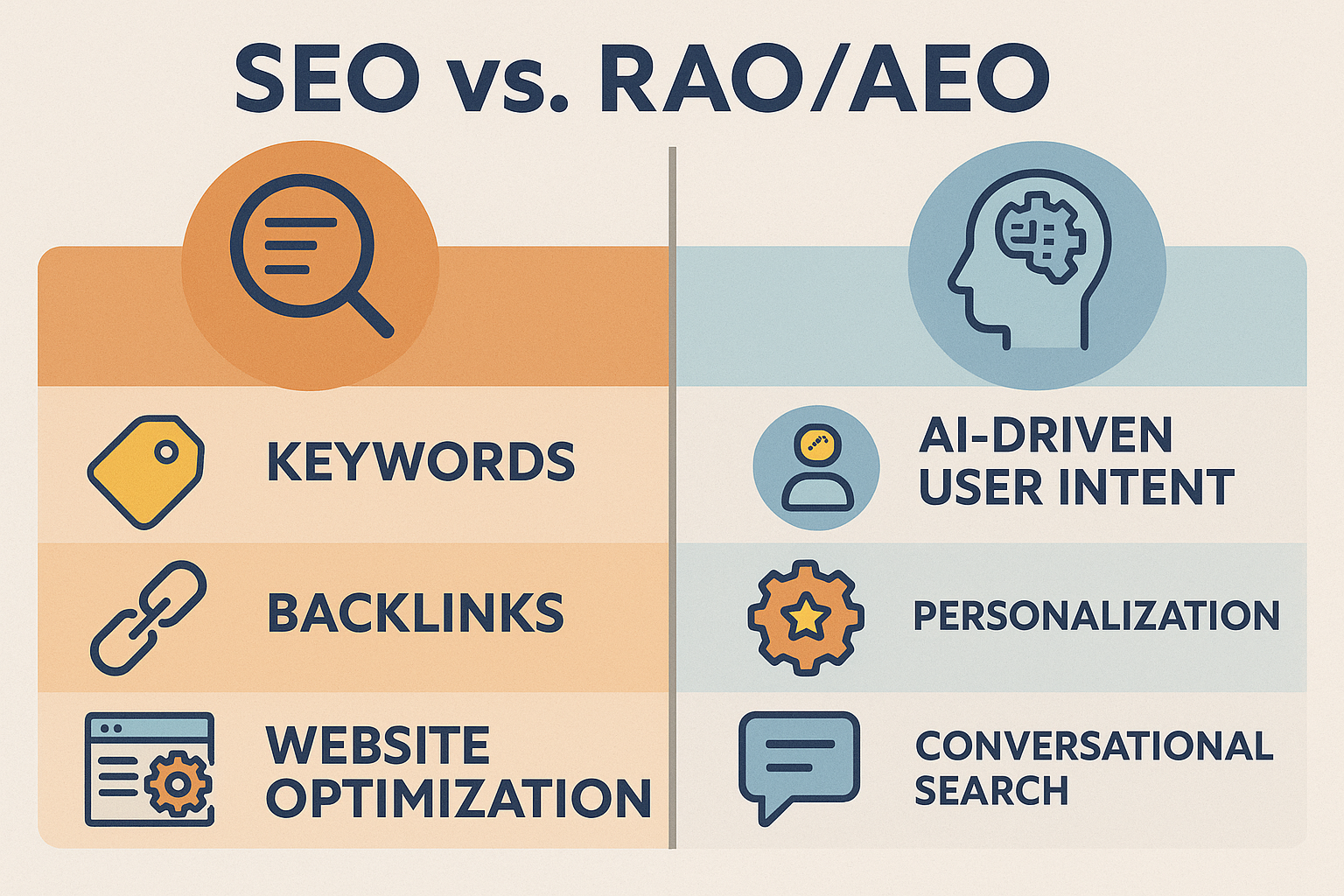 \n\n\n
The Traditional Role and Evolution of SEO
\nSearch Engine Optimization, or SEO, has long been the cornerstone of digital marketing strategies aimed at improving a website's visibility on search engines like Google. Traditionally, SEO revolves around optimizing web content to meet the algorithmic preferences of search engines, which include factors like keywords, backlinks, site speed, and user experience. The primary goal has always been to align your content with what users are explicitly searching for and to ensure your site is recognized as authoritative and relevant by search engines.
\nAt its core, SEO depends heavily on understanding human search behavior—how people type queries, what words they use, and how they interact with web results. This insight has shaped practices such as keyword research, where marketers identify the phrases and terms most commonly entered by users. Strategically placing these keywords in your content and meta tags helps search engines match your pages to relevant queries.
\nBacklinks, or links from other reputable websites pointing to your site, serve as endorsements that boost your site's credibility. Over time, search engines have used these signals to determine authority and trustworthiness within a given niche or industry. Alongside content relevance, factors like mobile usability and site speed have gained increasing importance as they directly impact user experience—a critical ranking factor as search engines prioritize sites that are fast and easy to navigate on all devices.
\nOver the years, SEO has evolved in response to updates in search engine algorithms and user behavior. While earlier SEO efforts might have focused heavily on keyword stuffing or manipulative tactics, modern SEO emphasizes high-quality, user-focused content that provides genuine value. This shift reflects the industry’s acknowledgement that search engines aim to serve users the most relevant and trustworthy information possible.
\nDespite these advancements, traditional SEO remains deeply rooted in the principles of indexing and ranking based on explicit search queries. It relies on well-established rules set by search engines, interpreting signals that are predominantly textual and link-based. These rules require continual adaptation, as search engines regularly update their algorithms to combat spam and enhance relevancy.
\nIf you want to dive deeper into how SEO continues to shape online visibility and why it should remain a foundational part of your marketing strategy, Delivered Social offers great insights into the evolution and future of SEO in the AI era. Similarly, SiteSmart Marketing provides a comprehensive look at how SEO integrates with emerging technologies, ensuring your approach stays current and effective.
\nIn summary, SEO’s traditional role is to optimize content in a way that search engines understand and rank favorably. It’s a strategy built on human search patterns, keyword relevance, authority through backlinks, and technical performance that enhances user experience. While the search landscape is rapidly evolving with AI technologies, understanding and applying these SEO fundamentals continues to be crucial for any successful online presence.
\nTo learn more about the nuances of SEO’s evolution and how it fits alongside newer trends like AI-Enhanced Optimization, visit Delivered Social and SiteSmart Marketing.
\n\n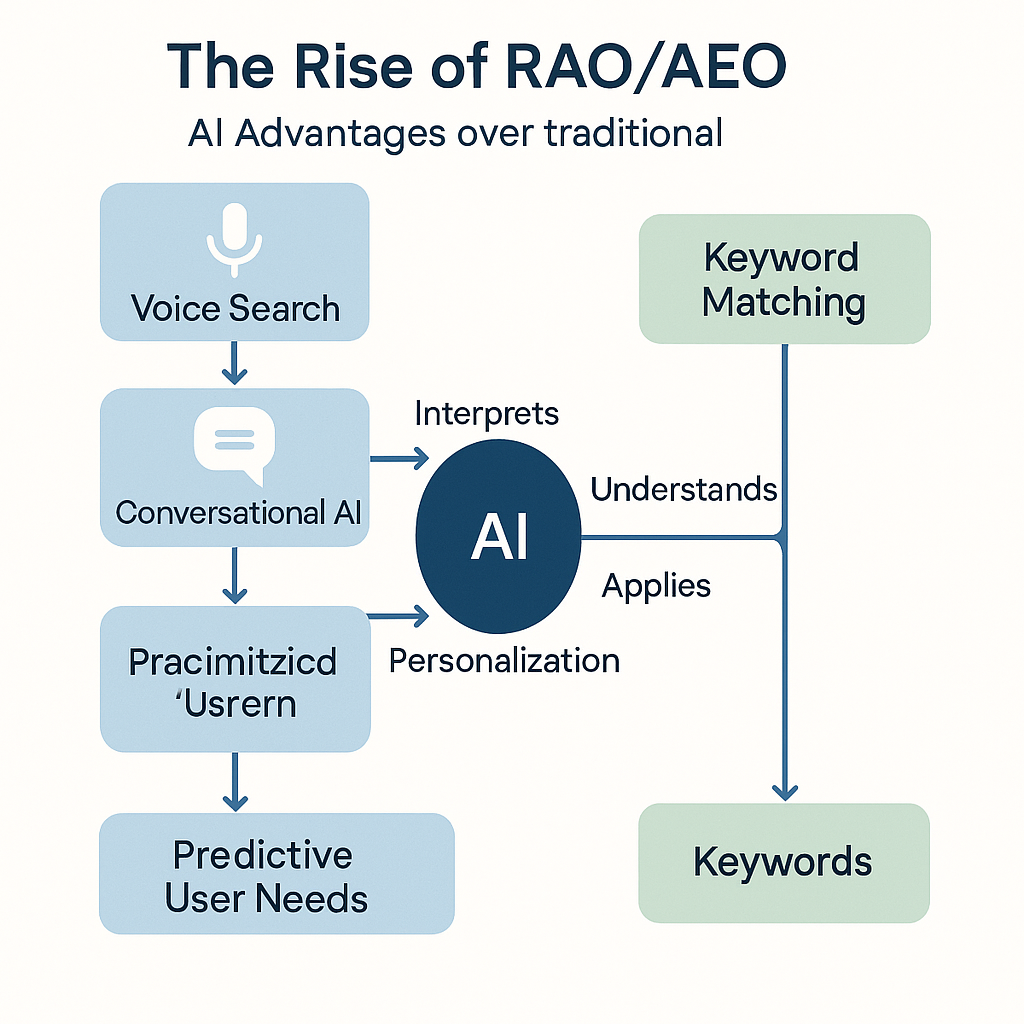 \n\n\n
Why RAO/AEO Outperforms SEO in Today’s AI-Driven Search Landscape
\nIn 2025, it’s clear that traditional SEO no longer holds the crown alone. The surge of AI-Enhanced Optimization (AEO)—often referenced as RAO in some circles—is reshaping how content reaches and resonates with users. To truly understand why AEO excels in this AI-dominant environment, we need to dive into three key areas: AI’s instant, conversational feedback mechanisms, the rise of voice search, and the critical role of personalization.
\n\n1. Instant Feedback in an AI-Powered World
\nUnlike SEO’s focus on climbing rankings over weeks or months, AEO thrives on real-time user interaction and response. AI systems process vast amounts of data instantly, interpreting user intent within seconds and adjusting results dynamically. This creates a far more fluid experience, where content is tailored moment-to-moment based on behavioral signals. In an era where users expect immediate solutions, AEO’s agility outpaces SEO’s slower optimization cycles.
\n\n2. Conversational and Voice Search Trends Driving Change
\nThe explosion in voice assistant adoption is a testament to this shift. According to The Social Byte (2024), over 135 million Americans use voice assistants daily. These assistants rely on AI to interpret natural language queries, which tend to be longer, more conversational, and context-dependent compared to traditional text searches.
\nAEO techniques optimize content by anticipating these spoken queries, structuring information to directly address common voice commands, and refining answers for succinctness—traits that make them highly compatible with voice search technology. SEO, with its keyword-heavy and link-building strategies, struggles to adapt as effectively to these nuances.
\n\n3. Personalization: The New Standard in Search
\nSearch engines powered by AI now deliver hyper-personalized results by analyzing a user’s past behavior, preferences, location, and real-time context. AEO leverages these insights to serve content that feels handpicked for each individual. This level of customization dramatically increases engagement and satisfaction.
\nAs Delivered Social (2025) highlights, AI-enhanced optimization taps into complex data sets that traditional SEO cannot fully utilize. Where SEO traditionally aimed for broad relevance, AEO narrows the focus to what truly matters to each searcher.
\n\nThe Future Is Collaborative: Combining SEO and AEO for Maximum Impact
\nWhile AEO presents a powerful evolution, SEO still plays a foundational role. The best approach today is a smart fusion—using SEO’s proven principles to ensure your site is technically sound and accessible, while layering in AI-driven insights and personalization that AEO offers. This hybrid method ensures not only discoverability but also engagement and conversion in a highly competitive space.
\nKeeping pace with AI trends means adapting your content strategies continuously. By focusing on natural, intent-rich language, fast and mobile-friendly site performance, and AI-optimized snippets, businesses and bloggers can stay ahead of the curve and capture the attention of users who demand relevant, instant, and personalized answers.
\n\nWhy SEO and RAO/AEO Work Best Together in Today’s Search Landscape
\nIn the rapidly changing world of search, many ask: Is SEO dead because of AI-powered search optimization, often called RAO or AEO? The simple truth is no. SEO is far from obsolete — it’s evolving, becoming smarter, and more integrated with AI-driven strategies. To get the best results, you need a blend of solid SEO fundamentals and the flexibility of AI-enhanced tactics.
\nTraditional SEO still matters greatly. It focuses on ensuring your website is technically sound, loads quickly, adapts to mobile devices, and offers quality content that matches what users type into search engines. This foundation remains critical as it helps search engines crawl and understand your website better. However, today’s SEO goes beyond keywords and backlinks. It embraces semantic search, which means search engines no longer just look for exact words but the entire meaning behind a query.
\nOn top of these SEO essentials, RAO or AEO brings AI’s power to the table. AI understands natural language nuances, user intent, and context far deeper than before. This shift is evident in how search results are personalized and how voice assistants and chatbots deliver instant, conversational answers. By integrating AI insights, you can tailor your content to real-time user behavior and preferences, making it far more engaging and relevant.
\nSo, how do you integrate the two in practice? Here are some actionable steps:
\n- \n
- Refine your content for intent and conversation: Write in a natural, user-focused way that anticipates questions and matches how people speak, especially for voice search. \n
- Keep technical SEO updated: Ensure fast loading times, proper metadata, and structured data that both search engines and AI tools can easily interpret. \n
- Use AI tools wisely: Incorporate AI for keyword research, content suggestions, and optimization but maintain an authentic, human touch that resonates with your audience. \n
- Optimize for zero-click results: Prepare your snippets, FAQs, and featured content to appear in AI-driven answer boxes, voice responses, and direct searches. \n
Industry leaders like SiteSmart Marketing and Lollypop Design highlight that neither SEO nor RAO/AEO alone can dominate the search landscape. Combining them creates a robust strategy to maximize your online visibility—leveraging structured, optimized content with AI’s ability to interpret and deliver exactly what users need.
\nIn conclusion, instead of choosing one over the other, businesses and bloggers should harness the strengths of both SEO and RAO/AEO. This balanced approach ensures your content is accessible, trusted, and instantly relevant in a world dominated by AI-powered search. Embrace evolution, and you’ll see your search presence thrive in 2025 and beyond.
\n\nPractical Tips to Thrive in the AI-Enhanced Search Landscape
\nAs search engines become smarter with AI, adapting your strategy isn’t just an option—it’s a necessity. Whether you’re a business owner or blogger, you can stay ahead by embracing the AI-driven changes rather than resisting them. Here are some straightforward, actionable tips to help you navigate this new terrain successfully.
\n\n- \n
- Focus on AI-Aware Keywords: Instead of chasing traditional keywords, aim for AI-aware keywords that reflect natural language, conversational phrases, and user intent. Think about how people speak or ask questions out loud—voice search continues to grow, so optimizing for these patterns is crucial. For example, instead of “best running shoes,” consider “what are the best running shoes for beginners?” \n\n
- Enhance Your Technical SEO: AI engines look beyond content—they assess how easily your site can be understood and navigated. Prioritize fast page loading times, mobile responsiveness, and well-structured metadata. Use schema markup to help AI better interpret your pages and serve your content for rich results, featured snippets, or voice assistants. \n\n
- Create Authentic AI-Assisted Content: AI tools can be fantastic helpers for brainstorming and drafting, but authenticity remains king. Your content should resonate with your audience by being genuine, helpful, and well-informed. Use AI suggestions as a starting point, then add your unique insights and voice to stand out in a world flooded with generic content. \n\n
- Optimize for Zero-Click Searches: More users get answers directly on search result pages or voice assistant replies without clicking through. Structure your content with clear, concise answers in FAQs, bullet points, or summaries. This makes it easy for AI to pull your content for instant answers, driving visibility even without user clicks. \n\n
- Stay Updated on AI Trends: The AI search landscape evolves rapidly. Make it a habit to monitor new developments, algorithm updates, and emerging tools that can enhance your strategy. Resources like Delivered Social and The Social Byte offer ongoing insights tailored for businesses and content creators. \n
By weaving these approaches together—blending traditional SEO strengths with AI-focused optimization—you’ll not only maintain your online presence but also thrive in a search environment increasingly dominated by AI. Remember, the goal is to meet your audience where they are and deliver what AI-powered searches are hungry for: relevant, authentic, and easily accessible information. Take these steps now, and your business or blog will be well-positioned to grow in 2025 and beyond.
\n\nConclusion: Why Combining RAO/AEO with SEO is Essential in the AI Era
\nAs we’ve explored, AI-Enhanced Optimization (AEO), often referred to as RAO in some contexts, clearly outshines traditional SEO when it comes to adapting to today’s AI-driven search environment. AI’s ability to understand user intent, context, and natural language nuances means AEO delivers far more personalized, relevant results—especially for voice searches and conversational queries where immediacy matters.
\nHowever, this doesn’t mean SEO is obsolete. In fact, the strongest strategy for maintaining and growing your online visibility is a smart blend of both. SEO provides the solid foundation—technical health, quality content, and strategic keyword use—that AI optimization needs to perform effectively. When combined, they create a powerful synergy, ensuring your content is discoverable and deeply engaging in ways purely algorithmic or keyword-focused methods alone cannot achieve.
\nAdapting to these AI-driven trends isn’t optional anymore; it’s essential if you want to stay relevant. Search engines are evolving rapidly, and so must your approach. Embrace AI tools, refine your content for conversational search, and keep improving your site’s technical aspects—all while staying true to SEO principles.
\nTake action today: start blending SEO basics with AEO strategies to future-proof your online presence. Stay informed on AI advancements and continuously adjust your approach. This balanced, forward-looking mindset will ensure you don’t just keep up with search trends—you set the pace.
\nFor more insights on mastering this evolving landscape, check out resources like Delivered Social and SiteSmart Marketing. Your audience is already searching with AI—make sure they find you first.