Call Center AI for SMEs: How Intelligent IVR System Recognizes Intentions and Redirects Calls Without Live Operator

Introduction: Revolution in Customer Service for SMEs
For small and medium-sized enterprises (SMEs), effective customer service via telephone presents a unique set of challenges. Traditional call centers demand significant investments in infrastructure, staffing, and ongoing training, often stretching limited budgets and human resources. The imperative to provide 24/7 support clashes with the reality of smaller teams, leading to long hold times, missed calls, and ultimately, frustrated customers. These issues directly impact customer satisfaction, retention, and brand reputation, hindering the growth potential of SMEs.
The solution lies in leveraging advanced technology to automate and optimize customer interactions. This is where Artificial Intelligence-powered Interactive Voice Response (AI IVR) systems emerge as a transformative force. Unlike rigid, menu-driven traditional IVR systems, AI IVR is designed to understand natural language, interpret caller intentions, and intelligently route or resolve inquiries without requiring a live operator. This paradigm shift in service automation makes sophisticated customer support not only accessible but also economically viable for SMEs.
Lumi Zone specializes in delivering bespoke AI and low-code automation solutions, including intelligent AI IVR systems. Our mission is to empower businesses to save time and work smarter by eliminating manual tasks and streamlining critical processes. By integrating an AI IVR, SMEs can overcome the limitations of conventional call centers, enhancing service quality while simultaneously achieving substantial operational efficiencies. This article will delve into the mechanisms, benefits, and practical applications of AI IVR, demonstrating how it can revolutionize telephone service for your business.

AI IVR systems are not just about automation; they are about intelligently understanding and serving customers, transforming a cost center into a value driver for SMEs.
What is Intelligent IVR System with Intention Recognition?
An Intelligent IVR (Interactive Voice Response) system represents a significant evolution from its traditional predecessor. While conventional IVR relies on pre-recorded menus and touch-tone inputs (e.g., "Press 1 for Sales, Press 2 for Support"), an AI IVR system harnesses the power of artificial intelligence to engage with callers in a more natural, human-like manner. Its core capability lies in intention recognition, allowing it to understand what a caller truly needs based on spoken language.
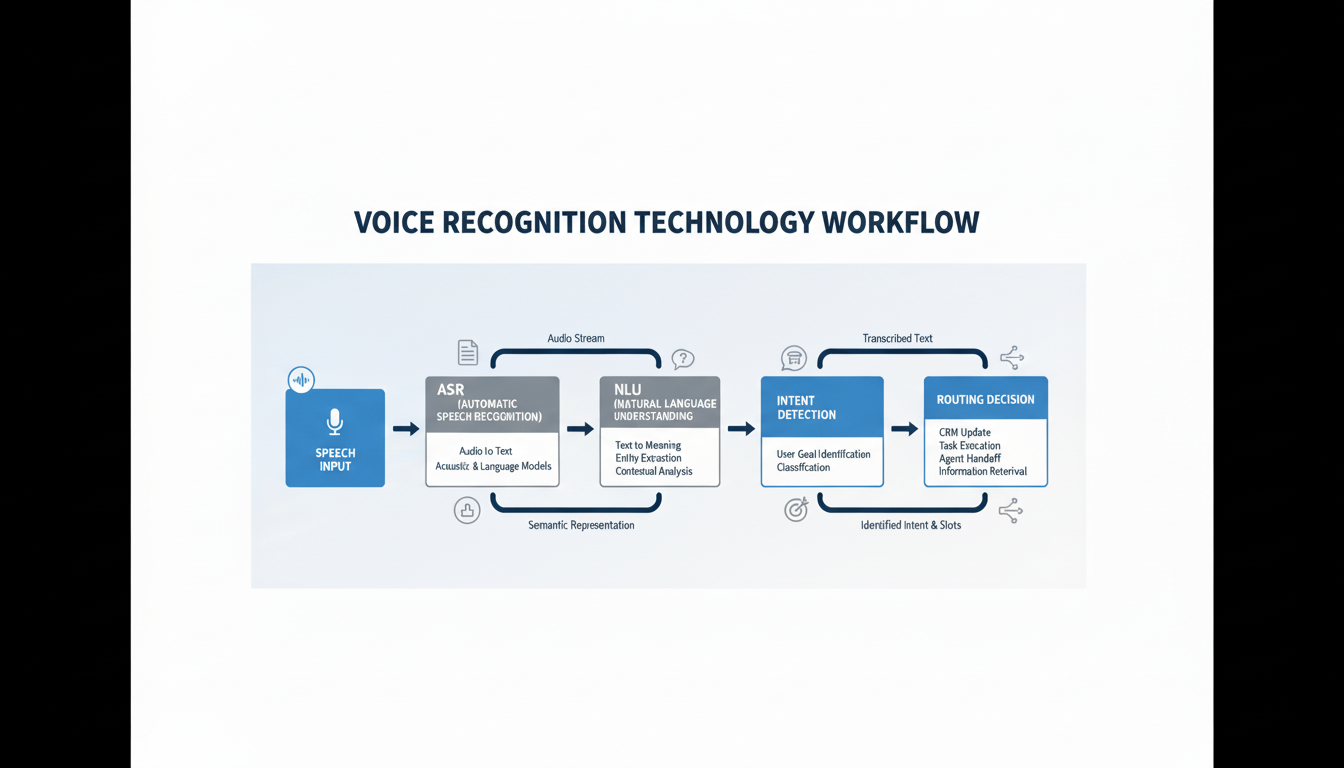
The system's operation involves several key components working in unison. First, Automatic Speech Recognition (ASR) technology converts spoken words into text. This is a crucial initial step, as the accuracy of the transcription directly impacts the system's ability to understand the caller. Once the speech is converted to text, Natural Language Understanding (NLU) comes into play. NLU is the brain of the AI IVR, processing the text to comprehend the caller's underlying intent, sentiment, and key entities within their request. For example, if a caller says, "I need to check the status of my order, which was placed last Tuesday," the NLU identifies "order status" as the intention and "last Tuesday" as a relevant entity.
The fundamental difference between traditional IVR and AI IVR is the shift from rigid menu navigation to dynamic, conversational interaction. A traditional IVR directs callers down a predefined path, often leading to frustration if their specific query doesn't fit a menu option. An AI IVR, conversely, listens to the caller's initial statement and immediately attempts to discern their goal. This eliminates the need for callers to navigate complex menus, drastically reducing friction and improving the overall experience.
The intention recognition process involves advanced machine learning models trained on vast datasets of human speech and text. These models learn to associate specific phrases, keywords, and even contextual cues with particular intentions. Once an intention is recognized (e.g., "make a payment," "reset password," "check refund status"), the system can then dynamically route the call to the most appropriate resource – whether it's an automated self-service module, a specific department, or the best-suited live agent, if human intervention is required. This intelligent routing ensures callers reach the correct destination faster, minimizing transfers and hold times. Lumi Zone builds these sophisticated, custom AI IVR systems tailored to specific business needs, ensuring precise intention recognition and efficient call handling.
How Does AI Work in Recognizing Callers' Intentions?
The sophisticated process of AI in recognizing caller intentions is a multi-stage technical journey, transforming spoken words into actionable insights. This capability is at the heart of an effective AI IVR system, enabling it to function as an intelligent virtual agent rather than a simple automated menu.
Step-by-Step Intention Recognition
-
Speech to Text Conversion (ASR): The process begins the moment a caller speaks. The Automatic Speech Recognition (ASR) engine captures the audio and converts it into a written transcript. This technology is highly advanced, capable of handling various accents, speech patterns, and background noise to accurately transcribe spoken words into text. The quality of the ASR is paramount, as any inaccuracies here can compromise subsequent steps.
-
Natural Language Understanding (NLU): Once the speech is converted to text, the Natural Language Understanding (NLU) component analyzes this text. NLU is a subset of AI that focuses on comprehending the meaning, context, and intent behind human language. It goes beyond simple keyword matching; it understands the semantic relationships between words and phrases. For instance, "I want to pay my bill" and "Can I settle my outstanding balance?" are recognized as the same intention: making a payment.
-
Intention Analysis and Entity Extraction: During the NLU phase, the system identifies the caller's primary intention. This involves classifying the request into predefined categories such as "payment inquiry," "technical support," "appointment scheduling," or "complaint submission." Concurrently, it performs entity extraction, identifying key pieces of information (entities) within the caller's statement. Examples of entities include account numbers, dates, product names, order IDs, or specific service issues. These extracted entities provide the necessary data points to fulfill the recognized intention.
-
Dynamic Call Routing and Resolution: With the intention and relevant entities identified, the AI IVR system can then make an informed decision on how to proceed. If the intention can be resolved through self-service (e.g., providing an account balance, confirming an appointment), the system guides the caller through an automated interaction. If the query is complex or requires human intervention, the system intelligently routes the call to the most appropriate live agent or department, often providing the agent with a pre-summarized context of the caller's intention and extracted entities. This significantly reduces handling time and improves first-call resolution rates.
Examples of Intention Recognition in Practice:
- Payments: A caller says, "I need to make a payment for my internet bill, my account number is 12345." The AI recognizes the intention as "payment" and extracts "internet bill" and "12345" as entities. It then directs the caller to the automated payment system.
- Complaints: If a customer states, "My recent delivery arrived damaged, and I'm very unhappy," the AI identifies a "complaint" intention, noting "damaged delivery" as the specific issue. It might then offer options to connect to a customer service representative or initiate a return process.
- Information Request: A query like "What are your store's opening hours this weekend?" is identified as an "information request" about "opening hours" and "this weekend," leading the system to provide the relevant schedule.
Learning and Improvement through Data
A crucial aspect of AI IVR is its ability to learn and improve. These systems are powered by machine learning (ML) models that continuously refine their understanding based on new data. Every interaction provides data—transcripts of conversations, identified intentions, and resolution outcomes. This data is used to retrain and update the models, enhancing accuracy in intention recognition, improving conversational flow, and expanding the range of queries the system can handle. Lumi Zone designs AI solutions that are not static; they evolve with your customer interactions, becoming increasingly effective over time. This continuous learning cycle ensures the AI IVR remains highly effective and adapts to changing customer needs and business operations.

5 Key Benefits of AI IVR for Small and Medium Businesses
Implementing an AI IVR system offers transformative advantages for SMEs, addressing critical operational pain points and driving substantial improvements across various facets of customer service. These benefits extend far beyond simple automation, fundamentally enhancing efficiency, cost-effectiveness, and customer satisfaction.
1. Significant Cost Reduction (80-90%)
One of the most compelling benefits for SMEs is the dramatic reduction in operational costs. Traditional call centers require extensive staffing, training, infrastructure, and ongoing salaries. An AI IVR system automates a large percentage of routine inquiries, effectively serving as a virtual agent that works 24/7 without breaks or salaries. By deflecting calls from live agents, businesses can achieve savings of 80-90% on call handling costs. This enables SMEs to reallocate human resources to more complex tasks, focus on strategic growth, or manage with a leaner customer service team.
2. 24/7 Availability and Accessibility
Customer needs do not adhere to business hours. With an AI IVR, your customer service is available around the clock, every day of the year. This ensures that customers can get immediate answers to their queries, resolve issues, or access information at their convenience, regardless of time zones or public holidays. For SMEs competing with larger enterprises, 24/7 availability is a powerful differentiator, significantly boosting customer satisfaction and loyalty by always being accessible.
3. Faster Issue Resolution
AI IVR systems are designed for speed and precision. By accurately recognizing caller intentions and extracting key information, the system can quickly direct callers to the exact self-service option or the most appropriate live agent. This eliminates the frustration of navigating complex menus, being transferred multiple times, or waiting on hold. The result is a significantly reduced average handling time (AHT) and higher first-call resolution rates, meaning customers get their issues resolved faster and more efficiently, leading to a much better experience.
An AI IVR empowers SMEs to deliver enterprise-level customer service with small business agility, making sophisticated support both accessible and affordable.
4. Better Customer Experience
A seamless, intuitive, and immediate customer service experience is paramount in today's competitive landscape. AI IVR enhances the customer journey by providing a more natural and personalized interaction. Customers appreciate systems that understand their needs without repetitive questioning or frustrating menu navigation. The ability to speak naturally and receive prompt, accurate assistance cultivates a positive perception of your brand, fostering trust and encouraging repeat business. A superior customer experience translates directly into higher satisfaction scores and stronger customer loyalty.
5. Enhanced Scalability
As SMEs grow, their customer service demands scale with them. Traditional call centers struggle with sudden spikes in call volume, leading to increased wait times and a degraded service experience. AI IVR systems, being software-based, are inherently scalable. They can effortlessly handle thousands of simultaneous calls without any degradation in performance, accommodating business growth or seasonal peaks without requiring additional human resources or infrastructure investments. This scalability ensures that your customer service capabilities can expand seamlessly with your business, providing consistent, high-quality support irrespective of volume fluctuations.

Use Cases: Where Does AI IVR Work Best?
The versatility of AI IVR systems makes them applicable across a wide array of industries and operational scenarios for small and medium-sized businesses. Their ability to understand intent and automate responses makes them invaluable for handling common, repetitive queries, freeing up human agents for more complex interactions. Here are several practical use cases where AI IVR excels:
-
E-commerce: Order Status and Returns
For online retailers, customer inquiries about order status, tracking information, or return procedures are frequent. An AI IVR can easily handle these by integrating with the e-commerce platform. A customer can call, state, "Where is my order?" or "I want to return an item," and the AI can prompt for an order number, retrieve the relevant data, and provide real-time updates or guide them through the return initiation process, all without human intervention.
-
Service Businesses: Appointment Scheduling and Changes
Businesses relying on appointments, such as clinics, salons, repair services, or consultants, can greatly benefit. Customers can call to "book an appointment," "reschedule my consultation," or "cancel my haircut." The AI IVR, integrated with a scheduling system, can check availability, offer slots, confirm bookings, or process cancellations, providing instant gratification and reducing administrative load.
-
Finance: Account Information and Transaction Queries
Financial SMEs, including local banks, credit unions, or investment advisory firms, can leverage AI IVR for secure, automated delivery of sensitive information. Callers can inquire about "my account balance," "recent transactions," or "loan application status." After secure authentication, the AI can provide this information quickly, enhancing customer convenience and reducing the need for agents to handle routine data lookups.
-
Complaints and Feedback Logging
While complex complaints may eventually require a human agent, an AI IVR can effectively triage and log initial complaint details. A customer calling to "report a problem with my service" or "give feedback on a product" can describe their issue to the AI, which captures the key details and routes it to the correct department with all necessary context, ensuring no complaint goes unheard and improving response times.
-
Basic Information and FAQs
Many calls revolve around frequently asked questions (FAQs) such as "What are your business hours?", "How do I get to your office?", or "What documents do I need for X service?". An AI IVR can instantly provide answers to these common inquiries, offloading a significant volume from live agents and ensuring consistent information delivery. Lumi Zone works closely with businesses to identify these high-volume, repetitive interactions perfect for AI IVR automation, turning potential bottlenecks into seamless self-service opportunities.

How to Implement Intelligent Call Center in Your Company?
Implementing an intelligent AI IVR system might seem daunting, but with a structured approach and the right partner, it can be a smooth and highly rewarding process. Lumi Zone’s expertise in custom AI automation ensures a tailored, effective deployment for your specific business needs. Here’s a step-by-step guide to bringing an AI-powered call center into your company:
1. Needs Analysis and Goal Definition
The first step is to thoroughly analyze your current call center operations and identify pain points. What are the most frequent call types? What issues lead to long hold times? What information do customers repeatedly ask for? Define clear objectives for the AI IVR, such as reducing call volume to live agents by X%, improving first-call resolution for specific queries, or extending service hours. This initial analysis forms the foundation for designing an AI IVR that truly addresses your business challenges.
2. Intention Configuration and Script Development
Based on the needs analysis, you'll work with your AI partner to define the "intentions" the AI IVR needs to recognize. This involves mapping common customer queries to specific actions or information. For each intention, initial conversational flows and responses are drafted. This isn't about rigid scripting, but rather about providing the AI with the necessary context and data to understand and respond intelligently. For instance, if "order status" is an intention, the system needs to know what information to request (e.g., order ID, email) and how to provide the status (e.g., read it aloud, send an SMS link).
3. System Integration
For an AI IVR to be truly effective, it must integrate seamlessly with your existing business systems. This might include your CRM, e-commerce platform, scheduling software, or internal databases. These integrations allow the AI IVR to access and update real-time customer data, personalize interactions, and automate processes like placing orders, checking balances, or booking appointments. Lumi Zone specializes in custom integrations, using low-code platforms and AI to ensure all systems communicate effectively without unnecessary complexity.
4. Training the AI Models
The AI models need to be trained on relevant data specific to your business and customer language. This involves feeding the NLU engine with examples of how customers might express certain intentions, along with relevant entity types. The more robust and varied the training data, the more accurately the AI will recognize intentions. This is an iterative process, with continuous refinement to improve performance.
5. Testing and Optimization
Before full launch, rigorous testing is crucial. This involves simulated calls covering a wide range of intentions, variations in phrasing, and edge cases. User acceptance testing (UAT) with real callers or a pilot group can provide invaluable feedback. Based on testing results, the system is optimized: intentions are refined, responses are adjusted, and ASR accuracy is tuned. This phase ensures the AI IVR performs reliably and effectively under real-world conditions.
6. Launch and Continuous Improvement
Once testing is complete and satisfactory, the AI IVR is launched. However, implementation is not a one-time event. AI systems thrive on continuous learning. Monitor key metrics, gather customer feedback, and periodically review call transcripts where the AI struggled. Use this data to retrain and update the models, expanding the AI's capabilities and improving its accuracy over time. Lumi Zone provides ongoing support and expertise to help your AI IVR system evolve, ensuring it remains a powerful asset for your customer service.

Measuring Success: How to Track AI Call Center Effectiveness?
To ensure your AI IVR investment delivers tangible returns, it's essential to establish clear metrics for measuring its effectiveness. Data-driven insights allow for continuous optimization and demonstrate the system's value. Here are key performance indicators (KPIs) crucial for tracking your AI call center's success:
-
Operator-Free Resolution Rate
This metric quantifies the percentage of customer inquiries fully resolved by the AI IVR without requiring transfer to a live agent. A high operator-free resolution rate indicates the AI's ability to handle common queries effectively, directly correlating with cost savings and increased efficiency. This is a primary indicator of successful automation.
-
Average Handling Time (AHT)
AHT measures the total time a customer spends interacting with the AI IVR or, if transferred, the combined time with the AI and a live agent. For AI-resolved calls, a lower AHT signifies faster issue resolution and a more efficient customer experience. For calls transferred to agents, the AI's ability to pre-qualify and provide context can also reduce the agent's handling time.
-
Customer Satisfaction (CSAT/NPS)
Ultimately, customer satisfaction is a critical measure. This can be tracked through post-interaction surveys (e.g., "Was your issue resolved by our automated system?"), Net Promoter Score (NPS), or Customer Satisfaction (CSAT) scores. While AI IVR aims for efficiency, ensuring it doesn't compromise customer experience is paramount. Positive feedback indicates that the AI is meeting customer needs and expectations.
-
Cost Per Call
By comparing the operational costs of handling a call through the AI IVR versus a live agent, you can accurately calculate the cost savings. This involves factoring in licensing costs for the AI system and dividing by the total calls handled by the AI, against the fully loaded cost per agent-handled call. A significant reduction in cost per call directly demonstrates the financial ROI of the AI IVR implementation.
Regular monitoring of these KPIs, combined with qualitative feedback, allows businesses to identify areas for improvement, refine AI models, and continuously enhance the performance and value of their intelligent call center. Lumi Zone emphasizes a data-driven approach, providing the tools and expertise to track these metrics and optimize your AI IVR for maximum impact.

Future of AI in Customer Service: What's Ahead?
The evolution of AI in customer service is accelerating, promising even more sophisticated and personalized interactions. What we see today with intelligent IVRs is just the beginning. The future holds capabilities that will further blur the lines between human and automated interactions, making customer service more proactive, intuitive, and efficient.
Emotional AI and Sentiment Analysis
Next-generation AI IVRs will incorporate advanced emotional AI and sentiment analysis. This means the system won't just understand *what* a customer says, but also *how* they say it. By detecting tone, pitch, and speech patterns, the AI can infer a caller's emotional state (e.g., frustration, urgency, confusion). This allows the system to adapt its responses, escalate to a human agent proactively if a customer is becoming agitated, or offer empathetic reassurance, leading to a significantly more human-like and satisfying interaction.
Deeper Integration with Chatbots and Omnichannel Experiences
The distinction between voice AI and text-based chatbots will diminish. Future systems will seamlessly integrate, allowing customers to switch modalities (e.g., start a conversation on chat, then transition to a voice call with full context transfer). This omnichannel approach ensures a consistent and uninterrupted customer journey, regardless of the communication channel chosen. AI will act as a central intelligence layer, orchestrating interactions across all touchpoints.
Real-Time Personalization
Leveraging vast amounts of customer data, future AI IVRs will offer real-time personalization. By accessing CRM records, past interaction history, and purchase behavior, the AI can tailor responses, offer relevant recommendations, and even anticipate needs. For example, if a customer frequently orders a specific product, the AI might proactively offer to reorder or provide updates related to that product, creating a highly customized and predictive service experience.
Proactive Need Prediction
Moving beyond reactive problem-solving, AI will increasingly predict customer needs before they even arise. By analyzing usage patterns, common issues for certain product types, or external events, AI could initiate contact with customers to offer support, provide timely information, or recommend preventative actions. This shift from reactive to proactive service will significantly enhance customer satisfaction and reduce inbound call volumes by addressing issues before they become problems. Lumi Zone is continuously exploring and integrating these cutting-edge AI advancements to ensure our clients remain at the forefront of customer service innovation.