AI in comment handling: help or risk?
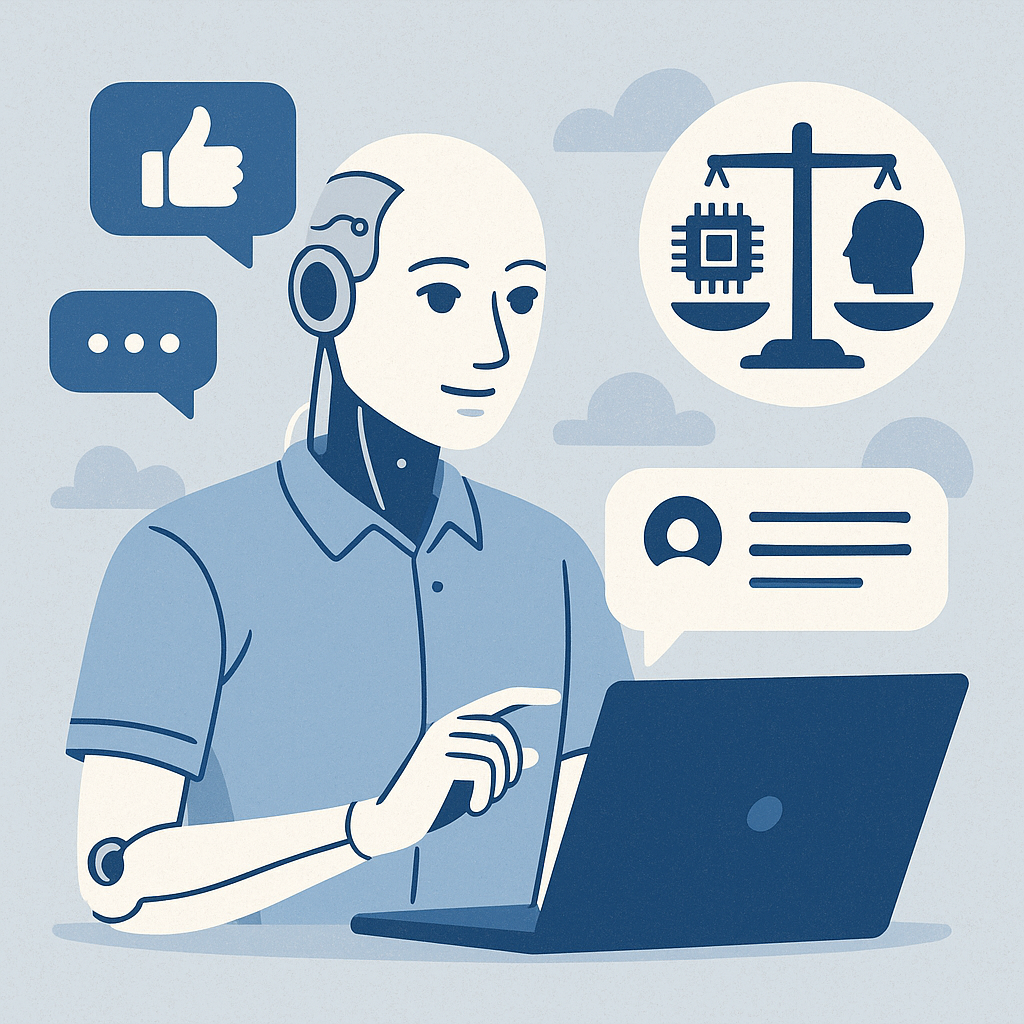
Introduction: AI in handling comments and private messages — help or risk?
Are you wondering whether automatically replying to comments and private messages is a time-saver or a potential threat to your brand image? In practice the answer isn't black-and-white. Automation does speed up communication and allows support to scale, but at the same time it carries risks related to authenticity, errors, and the company's reputation.
Algorithms vs. AI — a brief distinction
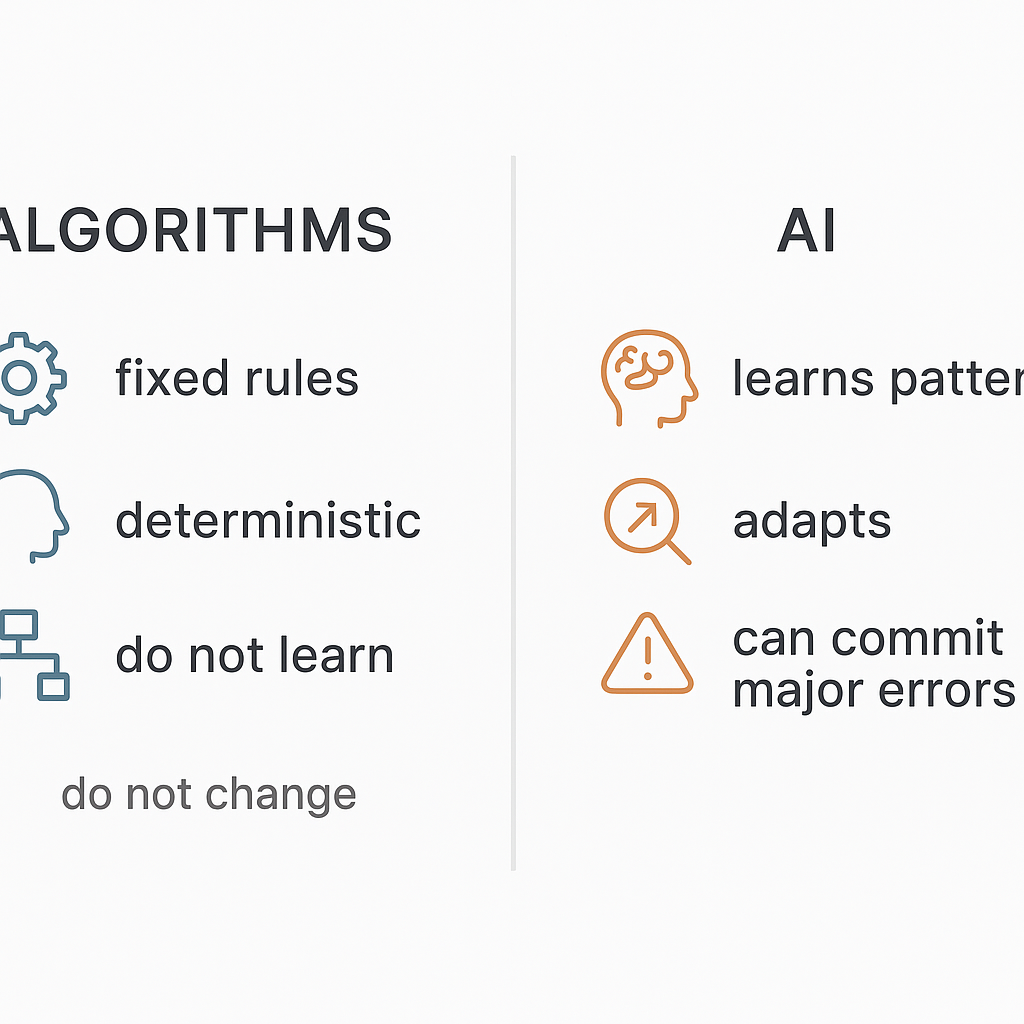
To start, it's worth distinguishing between two concepts:
- Algorithms — sets of clearly defined rules and steps. They do exactly what they were programmed to do, without self-learning.
- Artificial intelligence (AI) — systems that learn patterns from large datasets and, on that basis, can autonomously make decisions within certain limits.
AI can therefore analyze and personalize messages faster than simple scripts, but it can also reproduce faulty patterns on a large scale — if it "learns" bad behavior, the effects will be immediate and widespread. Importantly: AI does not possess empathy or morality — it operates according to the goals and input data you provide it.
Thesis of the article
Automation speeds up communication and increases efficiency, however without proper supervision it raises the risk of errors, loss of brand voice, and reputation problems. Therefore it is crucial to implement solutions with a 'human in the loop', clear escalation rules, and audit trails.
Who we are and how we can help
Lumi Zone is a modern agency specializing in low-code and no-code automation (including n8n). We help implement secure systems for replying, moderation, and message routing — so that your company gains speed and scalability while retaining control, authenticity, and reputation protection. We act as a partner: we design rules, introduce control mechanisms, and train teams so automation works to your advantage.
Want to delve deeper? We recommend reading:
3. Analysis of AI applications in handling comments and messages — opportunities and risks
Automation of customer communication using AI is today not only a trend but often a necessity. In this section we will analyze specific applications, benefits, limitations and technical tips that will help assess when to implement a simple rule and when to use a machine learning model. We also refer to research and expert opinions: see, for example, Monika Kołodziejczyk's analysis on the role of AI in social media (monikakolodziejczyk.pl) and critical remarks about AI limitations in a piece on Substack (dymek.substack.com).
Main applications
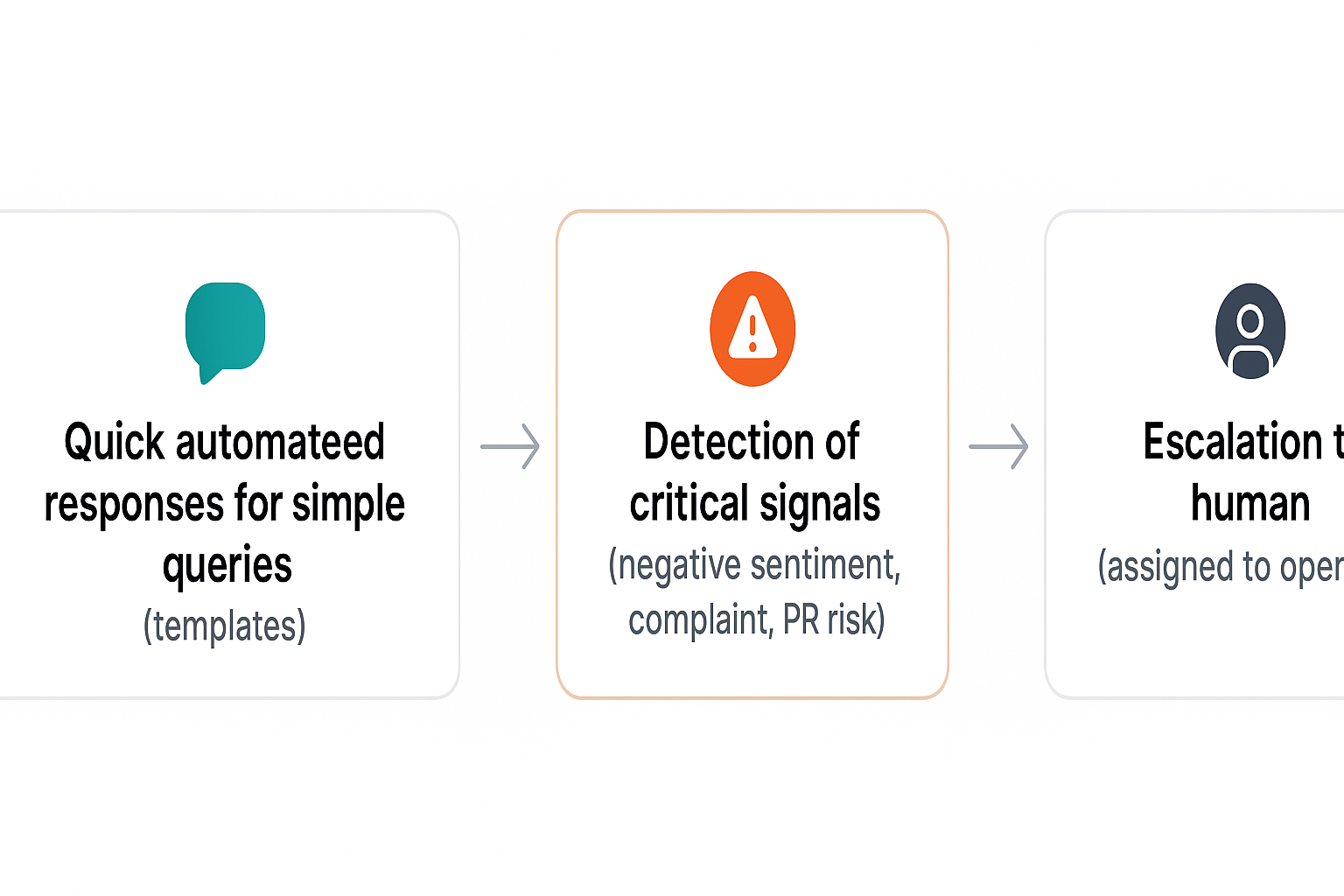
- Chatbots and automated replies: quick answers to FAQs, collecting basic data (order number, customer number), initial triage of inquiries.
- Classification and prioritization of messages: automatic tagging of topics (complaint, information request, positive feedback) and setting priorities, which shortens response time to critical issues.
- Sentiment analysis: detecting the user's mood (anger, disappointment, satisfaction) to dynamically route issues to the appropriate support channels.
- Content moderation: filtering spam, hate speech, malicious links — easing moderators' workload and enabling faster response to violations.
- Personalization of responses: generating messages tailored to the customer's history, language and tone, which increases service effectiveness.
Benefits
- Speed: instantaneous responses to simple queries increase customer satisfaction and reduce queues in the support system.
- Scalability: automated systems handle increased message volume without a proportional rise in staffing costs.
- Personalization at scale: AI can tailor messages to user segments and interaction history, improving conversion and retention.
- Resource savings: employees focus on tasks requiring empathy and creativity instead of repetitive replies.
- Real-time data analysis: instant reports on trends, product issues or PR crises allow rapid corrective actions.
Risks and limitations
- Lack of empathy: AI does not understand emotional context like a human — in crisis situations an automatic response can harm the relationship with the customer.
- Systemic errors and duplication of bad patterns: if models learn from historical data with errors, those errors are then reproduced at scale — it's a classic machine learning problem.
- Reputational risk: an inappropriate, poorly worded, or misclassified response can quickly spread on social media and damage the brand.
- Scale failures: a problem that was local can, with automation, affect thousands of users in a short time.
- Data biases (bias): models trained on biased data can discriminate against or ignore certain user groups.
- Legal aspects and privacy: processing private content requires GDPR compliance, data minimization, and secure storage — there is no room for shortcuts here.
- Need for human oversight: as critics note in articles (e.g., on Substack), AI is not a panacea — it needs continuous monitoring and escalation processes.
Real examples and brief case studies
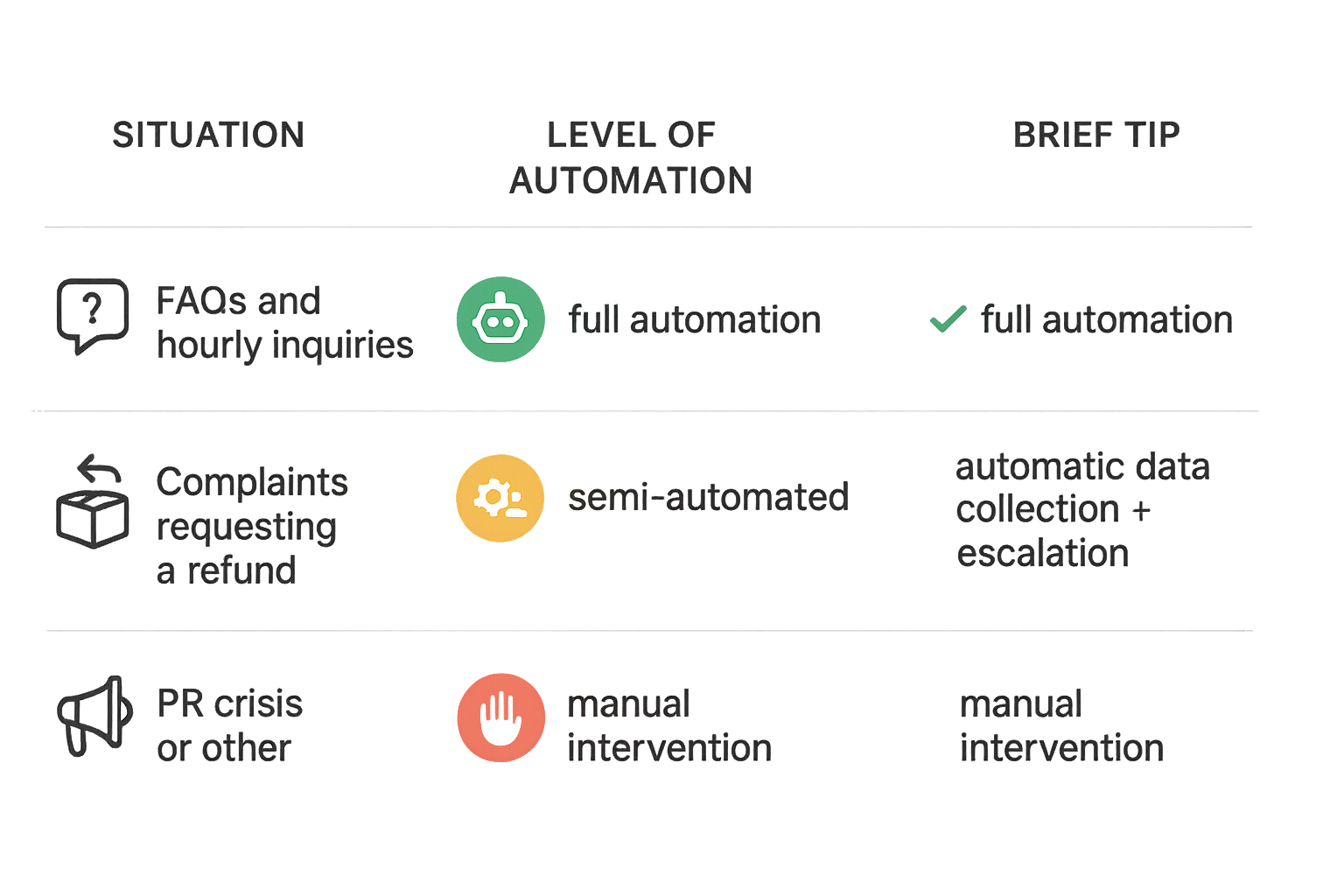
E‑commerce — handling complaints: AI classifies reports as "return", "product defect", "missing delivery", automatically generates a refund proposal, and cases with high negative sentiment are routed to the escalation team. Effect: shorter complaint resolution time and fewer escalations requiring manual intervention.
SaaS — user onboarding: a chatbot guides a new customer through basic setup, provides links to tutorials and collects feedback; technical issues are passed to support with the full context history. Result: higher user activation rate and reduced helpdesk load.
Small marketing agency: automated scaling of responses to inquiries allows immediate reactions — AI schedules an initial meeting, collects the brief, and the agency team receives a refined client profile. As a result, the agency increases the number of processed leads without hiring additional staff.
Technical notes — when to use simple algorithms and when to use ML/AI
- Simple rules (algorithms): ideal for FAQs, simple message routing, pattern recognition like "order number" or keywords. Fast, predictable and easy to audit.
- ML/AI: use when you need context analysis, sentiment, automatic personalization, or multi-class classification. Models learn from data but require validation and retraining.
In summary, AI in handling comments and messages is a powerful tool: it speeds up work, personalizes communication at scale, and provides valuable analytics. At the same time it carries risks that can be minimized through careful selection of technology, data quality, and continuous human oversight. If you wish, Lumi Zone will carry out a readiness analysis of your processes, implement secure solutions (hybrid: rules + ML), and ensure regulatory compliance — so that automation genuinely increases value for your business.
5. Practical implementation guide and rules for safe use
Do you want to implement AI for handling comments and private messages, but are you afraid of mistakes and losing control? Below you'll find a clear step-by-step action plan, a "Must do" checklist, suggested metrics, and ready-made example phrases. This is a practical guide you can use immediately in your company.
1) Preparation: defining the goal and scope of automation
- Define the goal: reducing response time, relieving the team, quick moderation, or increasing engagement?
- Scope: separate what the AI should handle — public comments (quick replies, moderation) vs. DMs (personalized replies, confidential matters).
- Choose channels: Facebook, Instagram, LinkedIn, WhatsApp, Messenger — focus on the 2–3 most important to start.
- Set KPIs: average response time (SLA), % of cases resolved automatically, escalation rate to a human, CSAT/NPS.
2) Designing tone and communication rules
Tone is the brand's identity in conversation. Design templates and rules before you enable automation.
- Brand persona: choose three words describing the tone (e.g., professional, empathetic, concise) and three examples of unacceptable expressions.
- Response templates: prepare variants for public comments (shorter) and DMs (more detailed).
- Escalation rules: define conditions for immediate handover to a human (e.g., requests for invoices, complaints, violence, profanity, legal inquiries).
- Privacy rules: automated requests for personal data only with confirmed consent and a clear statement of the purpose for which they will be used.
3) Technology: choice of tools and deployment practices
The choice of tools should match the scale and skillset of the team.
- Low-code/no-code tools and integrations: consider n8n to build flows integrating channels, databases and AI models — rapid development without heavy developer involvement.
- AI model vs rules: combine simple algorithms with an AI model — rules for safety, AI for personalization and intent classification.
- A/B tests: compare content variants, response speeds and escalation levels to optimize outcomes.
- Model versioning: save and version models/flows so you can quickly roll back changes after unwanted behavior.
4) Security and compliance
Data security and regulatory compliance are a priority.
- Conversation logging: record full interaction logs (excluding sensitive data) with access levels and retention in line with company policy.
- Data protection: encrypt data in transit and at rest, restrict access, use pseudonymization for analyses.
- GDPR compliance: obtain consents for data processing, provide access to data and deletion on request.
- Emergency procedures: define immediate shut-offs (kill-switch) and a response plan for incorrect answers/data leaks.
5) Monitoring and metrics
Monitoring allows you to quickly detect errors and continuously improve the system.
- Response time (Average Response Time) — compare automated vs. manual and set SLAs.
- User satisfaction (CSAT/NPS) — a post-interaction survey or sentiment analysis.
- Escalation rate — % of cases forwarded to a human; a high rate may indicate overly aggressive automation.
- False positives/negatives in moderation — measure how many errors the system makes when classifying content (e.g., false removals).
- Resolution effectiveness (Resolution Rate) — how many queries the AI resolves without human involvement.
6) Implementation plan and estimated timelines
- Pilot (2–4 weeks): run on a small channel or a limited group of queries; collect data and feedback.
- Gradual rollout (1–3 months): expand features and channels in stages while maintaining monitoring and fixes.
- Team training: train moderators and customer support on AI operation, escalation, and handling exceptions.
- Retrospective and optimization: every 2–4 weeks analyze metrics and make adjustments.
7) Example ROI
Here are realistic benefits you can measure:
- Faster handling: shortening the average response time from 6 hours to 30 minutes for simple queries.
- Work-hours saved: if you automate 60% of routine queries in a 2-person team (40h per week), you save ~24 hrs/week, which is ~96 hrs/month.
- Improved NPS/CSAT: faster responses and a consistent tone can raise CSAT by 5–10 points within 3 months.
- Cost reduction: less need for time-consuming manual moderation = lower operational costs and the ability to allocate the team to strategic tasks.
Checklist 'Must do' (8 points)
- 1. Define clear goals and KPIs before launching.
- 2. Split the scope: what AI automates, what requires a human.
- 3. Prepare templates and a communication persona.
- 4. Implement escalation rules and kill-switch.
- 5. Log all conversations and version models/flows.
- 6. Run A/B tests and controlled pilots (2–4 weeks).
- 7. Ensure GDPR compliance and data protection procedures.
- 8. Set up metrics monitoring and regular retrospectives.
Examples of phrases and rules for automated responses
- Public message (comment): "Thanks for the comment! We'll check this and get back with an answer. If you prefer privately, send us a DM." — short and transparent.
- DM — general inquiry: "Hi! Thanks for the message. Could you provide the order number or briefly describe the issue? This will speed things up." — request for necessary details without asking for sensitive information.
- Escalation to a human: "I'm forwarding your case to a specialist. Expect a response within X hours." — a reassuring message that sets expectations.
- Refusal/rules: "Sorry, we cannot provide legal advice through this channel. Please contact [contact]." — clearly set the boundaries.
- Privacy statement: "Your data will be used only to handle the request and stored according to our privacy policy." — brief, GDPR-compliant.
Do you want to safely implement AI and see business value immediately? Lumi Zone can help at every stage: process readiness audit, building flows in n8n and integrations, conducting A/B tests and model versioning, post-deployment monitoring, and team training. We offer a 2–4 week pilot after which you'll receive a report with metrics and recommendations. Contact us — we'll help design a solution that increases efficiency and minimizes risks.
7. Summary, recommendations, and call to action
AI in handling comments and private messages is a powerful tool: it speeds up responses, allows cataloguing inquiries and personalizing communication. On the other hand it carries risks — large-scale errors, lack of empathy, potential crisis escalation. The best strategy is a hybrid approach: automation (AI + algorithms) performs routine and repetitive tasks, while people verify, escalate and handle delicate cases.
Benefits at a glance:
- Faster and more consistent responses;
- Better scalability of support at lower costs;
- Personalized communication and more accurate recommendations;
- Automatic detection of negative signals (sentiment, spam).
Main risks:
- Replication of erroneous patterns by AI — requires continuous oversight (more: Aproco);
- Lack of empathy and context in crisis situations (OOH Magazine);
- Risk of algocracy and decisions made without clear rules (National Geographic).
Recommendation: hybrid approach (AI + human)
Automate what's routine; leave to people what requires empathy, creativity and responsibility. Such a model reduces the risk of errors while increasing efficiency.
6-point checklist ready for immediate implementation
- Conduct a quick communication audit — collect typical inquiries and response times.
- Define automation boundaries: which topics AI handles and which go to a human.
- Prepare ready-made response templates and escalation variants for critical cases.
- Run a pilot in n8n: test rules, scenarios and the escalation system on a small sample.
- Set success metrics (C-SAT, TTR, % escalation) and a monitoring schedule.
- Implement a feedback loop: regular reviews, model adjustments and team training.
Lumi Zone offer — how we can help
- Audit of current communication — analysis of messages, comments and processes; identification of automation points (time: 1 week).
- Pilot preparation in n8n — we will build and test the workflow with rules, templates and an escalation layer (time: 2–4 weeks).
- Implementation of templates and escalation system — ready response templates, priorities and rules directing to the team.
- Monitoring and optimization — we set metrics, dashboards and recurring reviews; first optimization 4 weeks after the pilot.
Typical cooperation process: audit → pilot (n8n) → implementation of templates and escalations → monitoring and optimization. In most cases the entire process can be completed within 6–8 weeks from project start.
Want to check how it works for you? Schedule a free consultation and pilot with Lumi Zone — we'll talk specifics, do a quick audit and propose a pilot tailored to your needs. Contact us via the form on the Lumi Zone website or reply to this post.